
How to Defeat the Far Right
Madrid · 04/09/26
Juan,
We’re about to set off. Well, you’re about to set off; I’m staying right here in my chair, which is what I do —it’s what I do now. But in this rather unorthodox way, I’m going to set off too: let’s see how it turns out. Besides, I just wrote down the date and as I did realized that it’s the anniversary of the Bogotazo, one of the great Latin American popular uprisings of the twentieth century, and I found myself wondering why this kind of citizen uprising doesn’t happen anymore. One could think it’s a normalization of the political system that funnels drive through more peaceful channels, but also that there are no longer goals or leaders capable of getting thousands and thousands of people to take to the streets and risk their lives to defend them.
In any case, it’s curious that this weekend holds two major manifestations of current politics: elections in Hungary and in Peru. You could say each process pushes certain traits of its region to the limit: in a region where heads of state don’t always last as long as they should, Peru is the country where presidents last the least; in a region where heads of state have been known to last too long, Hungary is the country where the last president has lasted the longest. Peru, however, is embarrassed by the fleetingness of its leaders; Hungary, on the other hand, was rather proud of the excessiveness of its own.
And, of course, that excessive leader is what all this is about —though let me tell you the journey we’re now getting into is a bit mad. You know how it went: José asked me to go to Hungary and write a piece on Orbán and his fifteen years in power. I loved the idea and accepted enthusiastically. In the three or four months that have passed since then my arms got more fastidious, I took a couple of trips which became riddled with complications, and I had to accept, rather sadly, that I wasn’t up for the task of going out to reportear (1), as some Latin American colleagues used to say and now, for lack of a better word, we all repeat. (It is a small victory when a word that perfectly encompasses a meaning replaces an imprecise one, or even two or three which were needed to say the same thing. “La palabra precisa, la sonrisa perfecta”, as you-know-who would sing before he started calling for prop machine guns.) (2).
But that’s not what we are going to deal with here. What I had to deal with is calling José and telling him I didn’t have the stamina, that I was sorry but I wasn’t up for it. I don’t remember if he then came up with the idea on the spot or if he called me back later suggesting we try this experiment: that you should go to Hungary and take care of all the looking and searching and asking and writing and all those things, and I, meanwhile, from my distant retreat in Madrid, could pose questions and suggestions while trying to collaborate with your search.
As you know, I’m a bit at a loss. I’ve always said there’s no point in trying to tell the story of a place, a situation, if you arrive burdened with preconceptions; my problem is that I’m only ever going to have preconceptions, because I’ll never be there, and your conceptions, which I suppose we’ll be debating while you are there.
Once again: I’ve also always said —it seems now I always say what I’ve always said— that in order to get rid of preconceptions and make an attempt at understanding, you need to go and get lost and look and listen. This time, you will be the one doing that, and, if anything, I’ll be the one who, looking from the outside, can point out certain things that the person up close sometimes can’t quite make out.
So I’ll be here, asking about what you ask, observing what you observe, being a pain in the ass, hopefully contributing something or other. As you know, since we talked about it a little, what interests me the most, what I would have wanted to go and observe, is how a society changes, how people change after fifteen years of a somewhat fascist government. Hopefully you’ll find those traces. It’s impossible to know «scientifically»: not even a great national survey could shed light on that. But it’s a matter of finding some people —some characters— who serve as evidence, who display the traits that strike you as most significant, and noting what they tell you and what you sense about the changes that happened all this time.
That’s the whole thing, or almost: Orbán’s regime was the first to be established on the principles which several others later followed, but none of them has been at it for even half as long as he has, so his country could be taken as a model, a preview of what could happen. Steering clear of clichés or fairy tales with a moral, that is what I’m interested in. Just do what you can: go, look, listen, detect. Stick to three or four main themes… That’s to say, during those days, decide which are the main themes and focus on them so you don’t branch out too much or end up building a catalog. Stick to those themes and find people and situations that materialize them, and if possible crossreference those with things Orbán and his people say or do, while also including enough political or historical context so all of this makes sense and is properly grounded. Also include enough of the general landscape so that is also grounded: it always surprises me how little effort we put into describing —and describing is easy: looking around and writing it down and finding, in what’s around, distinctive features, those that make a place stand apart, because there always are.
Sorry, I’m blabbering, stating the obvious. I’m just putting on paper —did someone say paper?— what I would try to do, if only I could. And it’s possible I’m blabbering because I’m saving the thing that gives me the most envy, that really eats at me, for the end. As chance would have it, things dragged on, and your trip might now come up to be more than the description of the first great far-right regime of this era: we can’t be sure, of course, but there’s a good chance you’ll get to witness its fall.
So, in short: pure envy. I remember some similar situations and I realize I’d really give a lot to be immersed in one again. But this time it’ll be you. I’m at your disposal to hear whatever you want to tell me or ask me; I’ll try to take part in some way I still haven’t quite figured out. I’ll pose questions, I suppose, maybe the odd suggestion here and there. To start with, I’ll try not to take up too much of your time, so I’ll say goodbye.
Safe travels and cheers!
M.
BUDAPEST · 04/10/26
Martín,
I’m writing to you from the plane. This space has become important to me lately, ever since I started traveling more, as if it were also part of the adventure. A moment defined not so much by silence as by the feeling of being far away, light, unreachable, which is another way of saying without a phone unfortunately. I can read interruptedly, think with less noise. I can only reach this state of suspensión —which the flight is barely able to capture, I suppose it’s really about the journey— when I’m far from home.
Right now I’m a bit nervous though. I’m going over the notes on Hungary I took these last few days and wondering whether this trip will be enough to do the job right and tell the story. It’s not about coming back empty-handed —I already have interviews lined up, and almost two weeks of reporteo seem like enough to find scenes and characters— but rather about the fear of not finding a narrative that does it justice. That which seems to come so easily to you: the tone.
Last week, when you told me about your doubts and I told you I had mine as well, that I was having trouble getting hooked on the story, you told me that used to happen to you too, but that you’d come to terms with it once you were travelling. This time you couldn’t do that though: you couldn’t work out a piece without being on the ground. Did you always have that confidence in the power of travel? Did you build it up over time?
I just finished your book on Videla, your latest one I think; it’s hard to keep up with you these months. I really liked the distinction you draw between personal hatred —the kind you might feel (or not) towards Videla, or towards someone who hurts or humiliates you, a hatred that’s alert or dormant but is yours— and that other kind of hatred: that which is collective. A sort of hatred manufactured by the leaders of their time, which turns out to be a kind of parody. A hatred with a purpose —political or economic— and therefore artificial. The first speaks to desire, the second to imposture. And in that ritual of simulation, with which a society, or a part of it, is complicit, lies its strength, its danger.
I keep thinking about the story we have to tell. José suggested this to you because Hungary became a model for the institutionalization of that kind of discourse: against migrants, gay people, anyone who’s different. We might say Hungary is a country where the parody of hatred became law. It allowed the creation of a regime that claims to aspire to that which we seem to be lacking so badly these days: security, community bonds, the feeling of being part of something bigger than ourselves. And it also allowed —does it still?—t he consolidation of a leader in power.
WE MIGHT SAY HUNGARY IS A COUNTRY WHERE THE PARODY OF HATRED BECAME LAW.
Although maybe we should be avoiding that Word —hatred. I mean here. So Orbán doesn’t come across as a champion of the worn-out, almost empty concept that is «hate speech.» This actually makes me a little suspicious of the people who use it.
These are just silly thoughts I’m having right now, as the plane gets closer to Budapest, and I try to get my nerves to ease up, let the adventure take its course, and let the words come, or settle into place, or, in any case, let you help me find them.
I’ll reach out soon for the first time, in the middle of election day. Maybe, in the end, it’s not such a bad idea that the trip begins with the elections: I’ll have some action and something to tell you right off the bat.
Just now, during the layover in London, I bought a couple of magazines (the other great pleasure of traveling: buying books and magazines you can’t get in Argentina, our own version of Miami (3)), and all of them were talking about the importance of this weekend’s election in Hungary.
Could Orbán really lose?
Best,
J.
PS. You began your letter with the anniversary of the Bogotazo. I just dated mine, and you won’t believe the coincidence: on April 10th 1919, Emiliano Zapata, the leader of the Mexican Revolution, was assassinated. I never cease to be amazed by how the Mexican state absorbed the symbols of the revolution, present in the names of streets, parties, and schools. It’s not only drive that gets channeled through institutional paths. There’s also imagery, words, emblems that are today reclaimed as pop culture. I think of the young Latin Americans who still make pilgrimages to Chiapas to get a taste of that past. And, in line with your question, I think the challenge isn’t just getting a lot of people to take to the streets, willing to give their lives, but that they do it for something, for a project that changes things at the root, the foundation of a new order: something that lasts over time.
MADRID · 04/11/26
Yes, Juan, sometimes I miss the time spent on the plane, not only because I can no longer make use of it the way I used to, but also because it’s no longer what it used to be. I was always very protective of that time of disconnection. I called it «plane time,» which sounds just like «plain time»: a simpler time, with no artificial additives or false flavors, a time in which you’re fully present where you are, and don’t fool yourself into thinking you can be everywhere at once like some two-bit god. I was very fond of that level of relief and concentration. But this was shattered a couple of years ago, when airlines started offering internet connection and, from then on, not checking your messages or the news or the nonsense on social media while bored in your plane seat became just as hard as not doing it while bored in your seat at home —in your bathroom, let’s say.
But these are trifles. What I do think is a good instinct is what you say about avoiding a portrait of hatred. On the one hand, because hatred is, in the end, a rather superficial emotion, the silly wish for someone to have a bad time, and better still if it’s on you. And because, for that very reason, we know it too well already, and there’s nothing interesting about going into its details: whether Orbán insulted these people or those, whether he mistreated such and such. I think all that gets you is one more entry in the endless list of complaints we’ve been logging since this far-right escalation began —since Orbán, precisely, first brought it to power. Complaints we still haven’t managed to counter, which have instead left us stuck in the comfortable and rather useless role of the victim: «Miss, he called me a fathead”. And the teacher looks at you and says, «You’re gonna have to tough it out and deal with it”, and so the other kid grins, knowing his little maneuvers still work.
So what I do think is worth doing, as I told you before, is to reach the end of this… dictatorship? and try to see how society has functioned —and still functions— after fifteen years of authoritarianism, social injustice, nationalist pride, and all those things you should try to sum up. That’s to say, how people lived, or still live, in the land of the far right; using this sad experience to try to understand where a government of that kind would take us, beyond our own particular traits. That’s to say, trying to foresee what Argentina would look like in 2035 if we were to let ourselves be dragged along by the current drift. And it might seem odd that a journalist’s job is to fore-see, but I suspect that if we try to see certain things, it’s in order to fore-see others, don’t you think?
And yes, I do trust that travel works. No specific reason: nothing to do with planes and customs and different languages and different traditions; I trust that travel works because, as I was telling you, it is —or rather was for me— a moment when you sharpen all your senses and are really able to watch and listen and sometimes even think. It’s what I’ve so often called the «hunter’s attitude»: the idea that, in a world we know so well we barely look at it anymore, it’s worth recovering the behavior of those primitive hunters who had to be absolutely alert, because they knew that if they missed the hare’s leap, neither they nor their families would eat that night. That’s why I trust travelling works, as does any situation of conscious «reporteo»: because you put yourself in that state of mind where you truly watch and listen, and that is a necessary —and sometimes sufficient— condition for beginning to understand things. This may sound like abstract theory, but you know it’s all real hands-on experience.
But now, on an even more real note, a last-minute shiver runs down my spine: all the polls have Orbán losing, yes, but when did we start believing in polls, wretched annals of erred predictions? Anyway, if they’re wrong and Orbán doesn’t lose tomorrow, we’ll have to rethink the whole piece. It wouldn’t be the first time, or the last, and it’s not even close to the worst thing that can happen to a journalist: having to reinvent yourself because reality, once again, has reinvented itself.
Eagerly waiting for the count, and the recount, and your account, and all of that.
Warmly,
M.
BUDAPEST · 04/12/2026
Martín, Orbán fell from power tonight, and the city rejoices. The opposition won the election by an absolute majority: a complete blowout. Even though the polls had predicted this result, hardly anybody had the certainty the regime could fall right at the start of the night, without resistance.
I’m writing to you from my room, in the small hours of the night. I want to put into practice what you always recommend: preserving the images while they are fresh, the sensations raw.
It took me an hour to get back from the center of the celebrations, in Buda. People are still lining up just to cross the Danube: the bridges are bursting with kids who keep singing and dancing and drinking and making out on the riverbank. On the other side, in Pest, the avenues are a symphony of honking cars.
I made it to the celebration alone, after slipping away from a gathering at David’s place. He’d thrown an asado for a mixed group, mostly Hungarians. Everybody had voted for the opposition and the mood was pleasant, warm, and David was dressed as an Argentine gaucho and handed out mates next to the parrilla —though calling it parrilla might be a bit of a stretch: it was a tiny square barrel grill parked in the yard of his grandmother’s house, where he runs his yerba mate warehouse (I’ll go into this later, I promise). The thing is, the Hungarians were too stuffed, comfortably poised in white plastic chairs, the unspoken heroes of every outdoor gathering anywhere in the world. Nobody wanted to leave. So I slipped out.
The party starts underground. People arrive by subway, with the cars becoming small grandstands blaring a repertoire of songs against the government which only occasionally mention the winning candidate’s name, Péter Magyar, the new president after sixteen years, a man who—at least physically—looks nothing like Orbán: he’s a well-preserved forty-five-year-old who looks like he’s into sports, and, let’s be honest, also looks like someone who knows how to have fun.
«Russians, go home!», the kids shout on the subway. Some travel wrapped in Hungarian flags, others in European Union flags, and some others in a combination of both. Two metalhead lesbians kiss as best they can. There’s not an inch of space left. At every station, both crowds —those watching from inside and those left helplessly standing on the platform— trade shouts and cheers. Their faces show pure joy, but also shock. On the platform, the young kids’ eyes go wide and they scream and shout when they see the crowd gathering. Nobody can believe the amount of people out there.
I follow the ritual as best I can, understanding nothing of what they’re singing except for a few words: Fidesz, Russians, Orbán. When I go up to someone and ask what he said about the prime minister, he answers: «son of a bitch.» Simple, almost elegant. He’s a 23-year-old kid named Jano who studied Spanish in high school. He’s carrying the EU flag. «This is like 1989, when we defeated the socialists,» he tells me. When he finds out I’m Argentine, he hugs me and says he loves my country. I think I can tell where this is going. «Here in Hungary, freedom prevailed too!»
At the station where we get off, the kids climb up the escalators, which are not running. A group of girls slide down the slope left between the handrails. We’re still underground. Outside, people are helping each other climb up onto the roof, the way people did during the World Cup celebrations with the metrobus. I see glimpses of bare butts, bodies bouncing on the roof, the noise adding to this blaring chorus. People crossing paths on the stairs —some going down, some going up— high five each other. Others hug. Besides the curses thrown at Orbán there’s techno music playing in the background, but it’s coming from below. It’s a group of otaku kids improvising a rave in the station, just off the platforms.
When I finally get to street level, I find myself completely disoriented. I have no spatial awareness, I don’t know where we are. The crowd renders me senseless. I know we’re near a castle and close to the Danube, that it’s a bit cold and we’re facing it packed together, though almost every group has a bottle of alcohol. Magyar is speaking somewhere in the distance, and some people clap their hands, but the shouting drowns everything out. I make a rough estimate: 80% of the people around me are under 35 and drunk. Families are standing further off. I see faces streaked with tears.
The fireworks start.
I sink into the crowd as if putting the car in neutral, except it’s my body, my head. I let myself go while I listen to music, howls of happiness, and fragments of the speech in this impossible language I no longer try to understand.
I give in.
On the roof of the subway station there’s a kid with a blue mohawk holding a Hungarian flag.
It’s a full on party.
And get a load of this stupid thing I’m about to say: it seems like a revolution.
It feels good.
Warmly,
J.
MADRID · 04/13/2026
Juan, you say it feels like a revolution, and nothing could speak to me more than that: I’m putting the finishing touches on my book about revolutions, which in the end looks like it is going to be called Revolution Isn’t What It Used to Be, and which opens with a couple of rather skeptical chapters on the survival of revolutions: how they seem to have disappeared from the map in recent decades, and how what’s left tends to be those revolts that could turn into a revolution but don’t amount to it.
We know that’s not what is going on in Hungary either: what’s happening is the result of a very legal election that, if all is confirmed, could change a regime that spent fifteen years resisting every change, enduring with vigor and purpose. At first glance, what strikes me the most in your account is the manner of the celebration: it looks a lot like what might have happened if Hungary, say, had won the Euro Cup, don’t you think? In any case it sounds a lot like what people told me happened in Buenos Aires when we —all of us— became world champions: what strikes me is that convergence, the way soccer and politics seem to be the only arenas that get this kind of popular reaction. Among other things, because we assume that politics change our lives and that soccer, in principle, doesn’t. If, given the likeness of their effects, we had to put one of those two propositions into question, which one would it be?
Anyway, the date is, once again, curious. Here in Madrid, yesterday, Sunday, April 12th, 1936, the parties allied against the king would comfortably win the election; today, Monday the 13th, no one would quite know what his majesty was going to do; tomorrow, Tuesday the 14th, he would abdicate, flee, and the Spanish Republic would begin, a supposedly new world. Talking about revolution.
Beyond the coincidence of dates and events, yesterday in Budapest nearly two-thirds of Hungarians voted against a man they had voted as their ruler for more than fifteen years. Throughout the day I heard reports saying turnout was much higher than usual, and that it was a bad sign for Orbán, and for a moment I even thought about making peace with democracy: it was clear that one of the most effective tricks the semi-dictator used to hold on to his high seat was making sure a short amount of people went up to the polls. Which is why a high turnout would lead to his defeat. It’s easy to see how powerful the right to vote is, which we exercise so little and so badly, forgetting that it is also our duty.
And now the first wave of joy witnessing how the forerunner comes down, and with him all the clowns in his circus, starting with the much-invoked Donald Trump and Javier Milei, and their long line of assorted imitators. Hopefully Orbán’s defeat will leave us with lessons that can help us gradually dismantle their dark fortresses and strip away the power of these foolish buffoons.
As you can see, I’m overflowing with optimism.
Enjoy!
M.
BUDAPEST · 04/14/2026
Martín,
I think we could start the story with another revolution. Or at least that’s what they call it here; I’d like to know how you think of it, and whether it appears in your book. I’m talking about the events of 1956, when a coalition of Hungarian students and workers rose up in arms against Moscow’s central power. Those were interesting times: Stalin had died a couple of years earlier and the Soviet Union was showing a certain degree of openness. It was time to act. The Poles had done it a little before, earning themselves some concessions. When the Hungarians tried it through a revolt that took to the streets and tore down statues of Soviet leaders —starting with Stalin’s own— the central power detected the first symptoms of a contagion that could be dangerous, and decided to intervene. The Red Army entered Budapest. The repression, which left thousands dead and hundreds of thousands displaced, was brutal but effective: within two weeks the revolt was smothered.
Referring to your book: was it really a revolution? Did it change anything?
Yes and no. The Communist Party’s authority was restored and, in the official narrative, the events of ’56 were labeled a «counterrevolution.» But Hungary came to be governed under a model that allowed a certain flexibility in its economy, one that set it apart from other neighbors within the Soviet orbit. Hungarians began to have access to Western goods, received tourists from the other side of the curtain, and enjoyed a vibrant cultural ecosystem. Political authority, on the other hand, was not up for debate. That arrangement worked for them until the end of the Soviet Union, and was known as «goulash communism.» I love the concept.
But, Martín, I also think about the celebrations the other night, with the kids draped in flags singing «Russians, go home,» and how it wasn’t hard to find allusions —in the press, on social media— to a «new» emancipation from Russia. The «revolution» didn’t change much, but some of that imagery got recycled into the language, where history repeats itself as a slogan.
(Maybe we should find another word: «revolution» is a bit of a stretch, yes, but «uprising»? Sounds too weak to me. «Outbreak»? I doubt it. «Revolt»? I like «revolt.»
As I was saying, we could start the story here, with this process rightly or wrongly titled revolution, because one of the first places I visit in Budapest is a park of Soviet statues called Memento. No doubt it’s a tourist attraction, the kind of experience you tend to avoid, but there’s something that catches my attention. The project came to be as an answer to the question of what to do with the communist monuments during the transition in the nineties, a problem shared by the whole post-Soviet area. But while most countries destroyed them, Hungary removed them from the public space and arranged them in this park-museum on the outskirts of Budapest, as if to keep history within a bus ride’s reach.
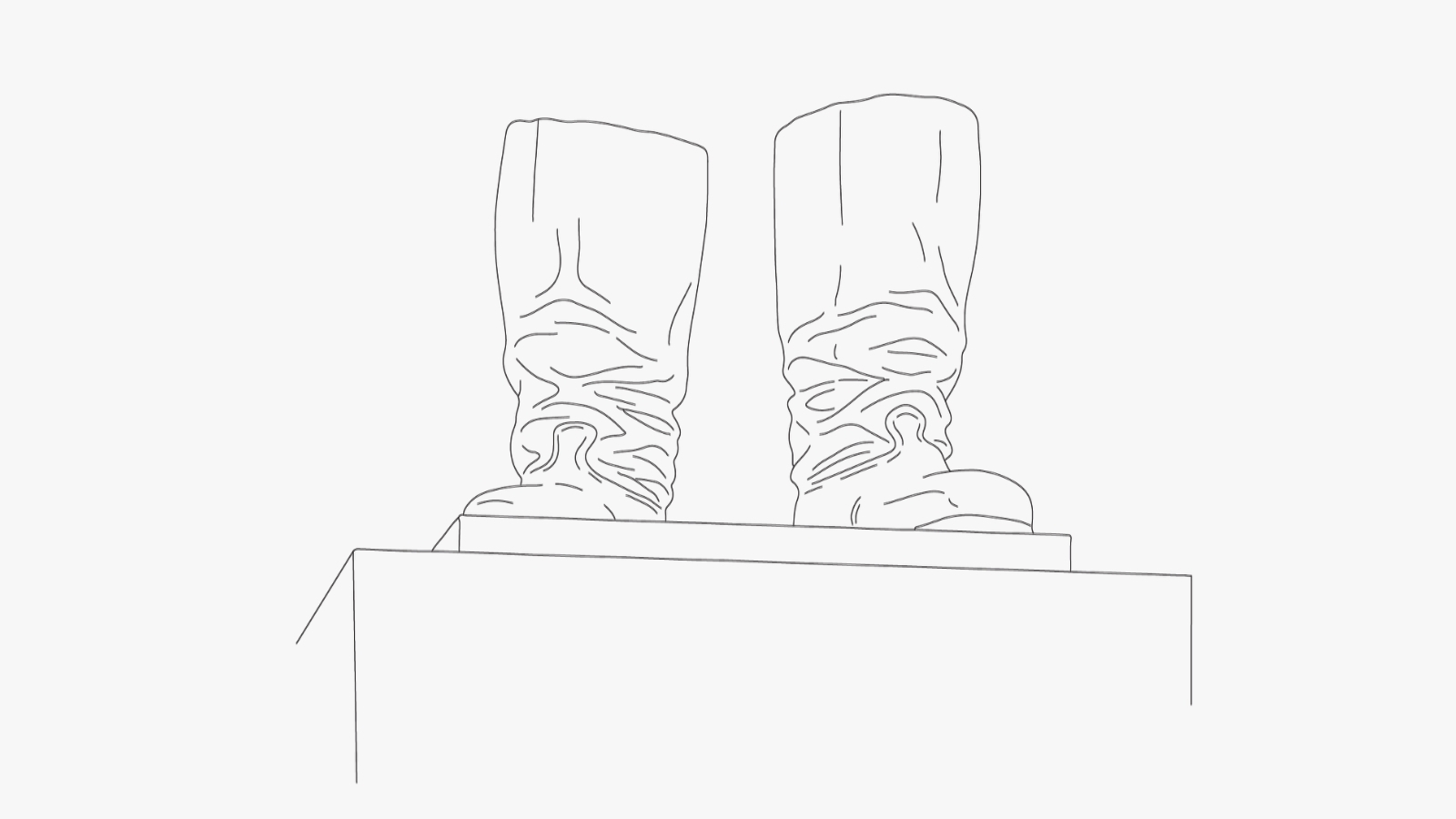
The statues are displayed outdoors, along a circuit that takes twenty minutes. All the statues —Hungarian and Russian Communist leaders, workers, the soldiers who crushed the ’56 movement— are in good condition, except for Stalin’s, whose main monument was torn down in the uprising, leaving only his boots, a kind of symbol the park also recovered and displayed at its entrance.
ALL THE STATUES —HUNGARIAN AND RUSSIAN COMMUNIST LEADERS, WORKERS, THE SOLDIERS WHO CRUSHED THE ’56 MOVEMENT— ARE IN GOOD CONDITION, EXCEPT FOR STALIN’S.
The project’s assistant is a sweet, small woman named Judit, who has worked at the park for seventeen years. She’s now forty, has school-age children, a more settled view of her country, and polished English, which she mastered when her father, a now-retired military officer, was posted to NATO in Brussels in the late nineties.
Let me linger for a bit on this story. György, Judit’s father, arrived in Belgium in ’97, two years before Hungary formally joined NATO as result of a bilateral agreement encouraged by the United States. By then he had already spent two decades in the army: a profession, or cause, he inherited from his father (Judit’s grandfather) who was also a soldier and who, among other things, fought against the students and workers of the ’56 movement. György joins the army because he wants to be a detective; he believes it’s a way to honor his commitment to his country but also to do something he likes —to honor himself. His father convinces him that the best way to start building that career is in the military service. The promise is never fulfilled: György goes to work in a tank regiment, climbs the ranks, and then, in ’86, is sent to the Soviet Union for training. He has a knack for languages: he learns Russian and masters English. These are good enough credentials to be proposed for the garrison of officers posted to Brussels when the geopolitical context shifts and Hungary begins to see itself as part of Europe.
«We wanted to be part of Europe and NATO because the memories of the Soviet occupation were still very fresh in our memories,» György told me the next day, when we met in the food court of a shopping mall in downtown Budapest. The resemblance between father and daughter is a little unsettling: György is also small, with soft features and green eyes, a man of nearly eighty in good shape, projecting the same calm, sweet, quiet air of his daughter —though I should probably put it the other way around. He retired from the army in 2017, after forty years of service. Now he’s a professional massage therapist. «I felt I had to give back some of the good things I’d received from my country over these forty years of my career,» he told me that afternoon, sitting in a café on the ground floor of the mall, which had that same gloomy, depressing atmosphere all closed-down shopping malls have anywhere in the world. The idea of going into massage therapy came to him a little before he left the army, when he had spinal surgery and recovered through massage and physical therapy in record time. «I felt so good with that rehabilitation that I thought it would be good to do the same for other people.»
He also travels when he can. Lately, when abroad, he found it hard to say he was Hungarian. He started to feel embarrassed by the government: «Europeans look at you with pity.»
Back to his daughter. It might be professional deformation, the product of a work routine tied to the Soviet period, but Judit says the ’56 revolt shows the conflicted relationship Hungarians have with foreign domination and with their own history, marked by a sense of grievance and bad luck: they always end up on the wrong side. In both world wars, they came out badly. In the first, when they were part of the Austro-Hungarian Empire —which they also tried to break free from in 1848, another failed «revolution»— they lost two-thirds of their territory. In the second, they were allies at first and then were invaded by the Nazis. Afterward they fell under the Soviet Union’s orbit («we just changed invaders,» they would later say). With an unfortunate location in the center of Europe, and that strange language, Hungarian, that doesn’t resemble any other.
«Nobody speaks our language, nobody understands us,» Judit complains, sitting on one of the wooden benches in the picnic area, a few yards from the souvenir shop selling Marx and Lenin magnets. «We could have disappeared! And here we are.» The survival of a language: a culture at risk of extinction. A homeland that is battered, threatened, always looked down on by its Western neighbors. «I know some Europeans from more modern or progressive countries look down on us. ‘Oh, you Hungarians, it’s unbelievable you’re still stuck in the mud. Why don’t you do something?’ And they’re saying that now. Well, we just take a bit longer than everyone else, but once we get angry, we’ll take down anything standing in our way,» she says, pointing to Stalin’s boots a few yards away.
In the nineties, as the Soviet Union was disintegrating and the countries in the bloc were starting to «take action”, Hungarians found the way to signal their break was to start talking about ’56 again. Powerful people began publicly saying that what happened then wasn’t a counterrevolution but simply a revolution. Dropping the prefix meant rewriting the story of the last few decades, but above all preparing the ground for the next. That narrative shift was materialized at a state funeral organized in 1989, in Budapest’s Heroes’ Square, to honor the leaders of ’56 and the murdered protesters. A hundred thousand people showed up and the event was broadcast on state television. It was confirmation that Hungary was opening onto a new era.
The most remembered speech that afternoon was delivered by a 26-year-old student leader, representing liberal youth. His speech was short but bold: he openly demanded the withdrawal of Soviet troops and free elections. The young man had potential. He was blond, cocky, good-looking, had presence and forceful oratory. Above all, he had a future. His name was Viktor Orbán.
Warmly,
J.
MADRID · 04/15/2026
Juan, it’s not easy to pin down what a revolution is in a world that calls almost everything a revolution: «There can be a revolution in fashion when a designer cuts seven centimeters off a skirt, a revolution in soccer when Cagliari takes the field with two left backs, a revolution in the kitchen when someone makes desserts out of brains,» as a nearly contemporary writer once put it. But the truth is that what happened in Budapest in 1956 was, at best, an attempted revolution that failed —because it never took hold. I’d call it an «uprising,» which is such a graphic word: it lifts up, it stands, it sets an action in motion. Have you noticed how some words, though they seem like synonyms, differ in that one names an action and the other a concept? Say: the difference between «uprising» and «insurrection»: they’re the same, but you can see the first one move, while the second stays still. Yet another case of that general rule I like to fire off at the slightest provocation: there’s no such thing as synonyms, every word is different from all others, and synonyms are a refuge for cowards.
But I like that what’s left of all those Soviet years is a park on the outskirts, almost like an afterthought, and I like that it’s called Memento, because the phrase where the Latin word memento has become most fixed in memory is memento mori, remember that you will die, that you are mortal. I don’t know if that was exactly the founders’ intention, but I like the pedagogical and vindictive idea of gathering in one place all the trophies of a conqueror who thought himself triumphant, as if to say: «this is what’s left of your arrogance”. As if, years from now, they gathered on some vacant lot on the outskirts of Washington the great ballroom and the so-called arch of triumph Trump is trying to build to celebrate himself, with a moral that stands to reason: «this is where that gets you», sic transit, memento mori. And I especially like the entrance with Stalin’s boots, pointing out that what’s left of your supposed greatness can be the most insignificant thing, like a hunk of bronze that smells like feet. Not to mention the other famous pair of boots, Mussolini’s, which took the place of his head when the partisans and peasants of a Piedmontese village hanged him upside down.
I LIKE THE PEDAGOGICAL AND VINDICTIVE IDEA OF GATHERING IN ONE PLACE ALL THE TROPHIES OF A CONQUEROR WHO THOUGHT HIMSELF TRIUMPHANT, AS IF TO SAY: «THIS IS WHAT’S LEFT OF YOUR ARROGANCE”.
But we were in Budapest, both exactly seventy years ago and the day before yesterday: its changes, its twists and turns. One of the main arguments of the book I’m finishing is that classic modern revolutions, despite their supposed intentions, changed very little in the lives of most people. I’m intrigued to see whether this Sunday’s election will bring any significant changes to the lives of the Hungarian people. No doubt they’ll have—already have—the satisfaction of having got rid of a leader who’d become a dead weight, with his corrupt little schemes and his whims. But it looks like the general orientation, the broad political lines, won’t be very different. It seems the guiding principle «God, Family and Country» will remain, with slight updates.
It’s funny that the slogan —if you’ll pardon the word— which seemed so very antiquated has yet again come back to life, with its national and regional variations. One of them, in Hungary, is that the notion of God and all the religious paraphernalia were heavily neutralized during the forty-five Soviet years: the two generations that run the country today grew up without much exposure to crosses, and yet they offer them, and millions take them in. Even so, religion there seems to carry less weight than in other European countries. To make up for it, there’s the concept of country. Country, of course, is always there: it’s the great contemporary construct —whose virtues include making us believe it’s neither a construct nor contemporary. On some other occasion when we are less restricted by time and space, we can discuss the fallacy of countries being perceived as eternal ontological entities, when the vast majority are inventions not even two hundred years old.
But naturally that widespread invention also comes with plenty of nuances. Every country is presented as a thing to be defended and loved, but none more so than that which has been battered, chronically mistreated, and needs to be healed and looked after with special care. Hungary perceives itself as one of those: a small society with its own culture, a language nobody else understands, a spot on the margins, which is why it changed hands so many times. This beaten country needs, more than any other, a fierce defense: the Hungarian nationalist movement has very few foreigners in it, and that’s why, to defeat an ultra-right ultranationalist, it took a right-wing ultranationalist whose surname —the joke tells itself— happens to be «Hungarian”, that is what «Magyar” means in Hungarian. (I’m making a note to myself, I solemnly promise never to vote for someone named Argentino, or the female version of the surname.)
And the third leg of the featherless biped, family —or what the right understands by it— doesn’t seem too threatened: from what I’ve heard, Magyar isn’t going to come out against abortion or the gay world as much as his old boss did, though that’s not entirely certain either.
But let’s not get ahead of ourselves. Before we get into Orbán’s defeat and the reasons for Mr. Hungarian’s victory, I’d like you to tell me a bit more about what you’ve been able to learn about the trajectory of the great illiberal chief: how does a man with educated, almost progressive origins turn into the great chieftain of a nationalist and superstitious tribe, if you’ll excuse the phrase? How does he transform, and, if at all, how does he manage to get so many others to transform along with him? How does he get so many others to join him on a path that not long before didn’t even seem to exist?
That, I think, is the most staggering thing about these last few years: that in different places, in different ways, we’re going down a road that didn’t exist before; and this road–shitty as it is–is being built as we walk. That’s why, I think, it’s worth doing everything possible to understand how this road that’s taking us God knows where came to be paved.
And it’s not even clear that we want to go there.
Best,
M.
BUDAPEST · 04/16/2026
Back to the nineties, Martín, if only for a moment.
A year after that famous speech, Orbán entered the Hungarian parliament through the Fidesz party, the Alliance of Young Democrats (curious that they kept the acronym). Rather than left-wing or right-wing, the group declares itself liberal, and is made up mostly of university kids fascinated with Western intellectual life, who want, in short, for Hungary to become a liberal democracy, and who come, needless to say, from relatively well-off families. That’s not Viktor’s case, since he was born into a lower-middle-class family in a town an hour away from Budapest, but it is the case for his classmates at Bibó, one of the capital’s leading elite schools, which Orbán manages to get into, in a move that will change his life (and, in time, the lives of millions of Hungarians).
Bibó is what the British would call a college: a residential institute for advanced studies, before university. It’s there that Orbán connects with these liberal young people who define themselves through their opposition to communism, and where he begins to shape himself into a lawyer with political leanings. People who knew him in those years describe him as a brilliant kid, genuinely worried about the transition to democracy, a cause the young Viktor pursued with a certain intransigence when it came to the negotiations between the socialist government and the opposition (as someone who took part in those negotiations told me, «He didn’t want compromises with the regime: he was maximalist and inflexible»). As a student, Orbán was diligent, but seemed consumed by his ambition: he’d stay up studying very late and wake up early, with no awareness of what was going on around him. One day his roommate suggested he should rest a little more, because that routine could hurt him. Orbán said nothing: he answered by beating his chest like a gorilla.
The roommate’s name is Peter Molnar, and I’m meeting him for lunch. It’s only thanks to Orbán’s defeat that Molnar wants to or is able to talk about those years, which for him mark the beginning of a traumatic experience. A Fidesz co-founder, he rose to become the party’s vice president and a fellow member of parliament alongside Orbán, until he left in the mid-90s, when the authoritarian drive had become obvious. Molnar now organizes poetry slams and lives the routine of a bohemian artist, a turn that literally saved his life. But for now it’s important we stay in that moment, the mid-nineties.
AS A STUDENT, ORBÁN WAS DILIGENT, BUT SEEMED CONSUMED BY HIS AMBITION: HE’D STAY UP STUDYING VERY LATE AND WAKE UP EARLY, WITH NO AWARENESS OF WHAT WAS GOING ON AROUND HIM.
Orbán rehearses in Fidesz what he’ll later do to all of Hungary: he takes control of the party’s governing board, monopolizes decisions, and shuts out his internal rivals, with whom he fights over the direction of the project. By 1994, in the party’s second-ever election, he’s no longer convinced by that idea of young liberals who declare themselves neither left nor right. No, Orbán wants Fidesz to be right-wing, center-right for the time being, and he makes that clear to his internal rivals, who begin leaving the party. Already in 1993 he had toyed with Fidesz’s official orientation, adding the label «national» to the «liberal» tag.
Orbán’s turn had a tactical purpose: he wanted to take advantage of the wear and tear suffered by the center-right —which, as in almost all the new post-Soviet democracies, came to power after the transition, with dismal results— in order to establish himself as the main alternative to the left-wing coalition.
That move would not pay off in the 1994 elections, when Fidesz lost seats and the left won by a landslide. But in the next one, 1998, he was vindicated: Fidesz won the election and Orbán became prime minister at 35, the youngest in Europe.
The question has obsessed me since I got to Budapest, and in a way it’s shaping my interviews with the people who lived through that moment: how do you explain Orbán’s turn? What was in this (no longer quite so) young man’s mind, who a few years earlier had been showing off his liberal credentials and had managed to charm intellectual elites across Europe to the point of receiving a George Soros scholarship to study at Oxford?
Quick answer: there was no liberal majority in Hungary. And to rule the country it wasn’t enough to be centrist, democratic, pro-European. You were either left-wing or right-wing. And Orbán was on the right.
Orbán’s arrival in government drives Peter Molnar into a crushing depression. In ’94, having already left Fidesz, he’d managed to renew his seat in parliament as part of another liberal party. But by ’98 he was already out of politics altogether. Molnar finds himself unemployed, without any clear purpose, at the mercy of sudden anxiety attacks that leave him in a kind of trance.
We’re halfway through lunch. Molnar speaks in a whisper. He’s the same age as Orbán (62) but gives off a completely different vibe. His former friend is heavy-set, solid, a modern-day ogre in a suit who speaks Hungarian in short but firm sentences, as if he were belching. Molnar thinks as he talks, in a thin, almost irritating thread of a voice, and with a pitiful look about him: he’s a stooped, short man, with a soft face and pale eyes, who arrives at the restaurant wrapped in several old corduroy garments and who, to make matters worse, warns me beforehand that he can’t pay for lunch. He was the one who suggested this restaurant, the kind Europeans call a bistro, a small, elegant place a few yards from St. Stephen’s Basilica, a neo-Gothic cathedral that dominates the center of Pest. From the window you can see tourists stopping to take photos of it before moving on down a pedestrian street lined with cafés with signs in English, all the way to the (gorgeous) bookstores that sell books in English. Molnar also speaks good English, because he was a member of parliament and studied in the United States, which is why the warning that he can’t pay makes me doubt him at first; then I understand, watching and listening to him, that he’s serious, speaking from another life.
The story is a lovely one, involving water and poetry. Having left politics, Molnar started swimming every week; exercise heals him. «Swimming keeps me standing,» he tells me. He also started writing more forcefully, and taking part in poetry slams, a legacy from his time in the United States when he was training as a lawyer. He immersed himself fully into the world of slam poetry, and now runs a cultural publication devoted to it, organizes events, gets close to young people.
In 2018 he became European slam poetry champion with a performance dedicated to Orbán and the chapter of his life he had left behind.
We wanted a democracy that would make the world go: wow!
We got it.
Just in a different way.
Later, in another passage:
Do you remember
what I asked you
before falling asleep
at the Bibó dorm
of our law school?
What will happen
if we manage to build democracy,
but once again
someone gets too much power?
I looked for the video to send it to you. It’s been a few years, true, but now I see that skinny fifty-something surrounded by young people, so alive, so deeply connected to what he’s doing, that the rest of his story—Orbán, his entry into politics, the turn to the right, the elections —seems almost beside the point to me. And if religion, country, or family can be a lifeline, a source of meaning in an increasingly uncertain world, a passion can be one too. Why wouldn’t it?
A few more words about Orbán.
The man held office between 1998 and 2002, when he unexpectedly lost the election. It’s while being the opposition that he consolidates his shift to the far right, converts to Christian nationalism, and starts using words like country, identity, tradition. Zsuzsanna Szelényi, another former fellow who also co-founded Fidesz and left alongside Molnar, writes about that turn in her book:
Orbán believed that national identity satisfied important sociopsychological needs, at a time of frustration with the post-Communist transformation, when society had to withstand both an economic crisis and a cultural shock.
There was a void that progressives and liberals couldn’t fill, Szelényi concedes, and elsewhere in the book she admits she herself once thought that «in the open world the European Community proposes, national borders between us would become virtual.»
From the opposition, Orbán built a movement known as «civic circles,» where religious pastors, who had previously kept their distance from parties, started taking part. He himself starts to sound like one. He talks about «Christian love» and warns of a world run by people who claim «that you should only worry about what you can get quickly.»
About things that require no thought, no deep feeling, no sacrifice, no commitment, no loyalty. Things for which there’s no need to love or trust anyone else.
This is the foundation of what, years later, on his return to government in 2010, Orbán will label «illiberal democracy,» of which Hungary will become the leading global example. This would serve as a facade for controlling institutions, the press, and persecuting sexual minorities.
You asked me a while back about the transformation of the model. In his first term Orbán captured the state, taking advantage of the absolute majority in parliament: he changed the constitution, reformed the electoral system, and took control of the judiciary and the media. Already in his victory speech he’d warned that the mandate he had received from the voters was not simply a change of government. It was a change of regime.
The idea settled in from 2014 on, when Orbán won a second term with an absolute majority. That’s when he started talking about the illiberal state. Besides his refusal to take in refugees from the Middle East, Orbán targeted progressive groups, NGOs, and even universities, like the Central European University, founded by Soros, which will eventually move its operations elsewhere. The public posters of a grinning, gluttonous-looking Soros under the slogan «Stop Him,» a campaign that traveled the world, date from that period.
In 2018, he won a third term with an absolute majority. By then, both he and his circle of friends are billionaires, the richest in the country, benefiting from state contracts under a growing economy, helped along by his closeness to Russia and China, which invests in Hungary more than in almost any other country in the European Union, as if it were a gateway, a reliable ally in unstable territory.
When the pandemic hits, Orbán uses emergency powers to tighten his grip on the state and go after his rivals, among them civil and human rights organizations. By then Budapest was already a mecca for the anti-progressive movement, drawing far-right politicians and influencers on pilgrimage from all over the globe. Orbán won his fourth and final term in 2022, just before the economy began to falter in earnest, on the promise of not passing on the costs of the brand-new war in Ukraine to his citizens.
I keep coming back to the word revolution, which leaders like Orbán have tried to embody in reverse: a conservative revolution. And also to the fact that I’ve used the word «liberalism” a lot without dwelling much on it, or on its parent concept: liberty.
What do you think, Martín, of this new concept, «illiberalism”? Do you think it’s worth taking seriously?
Warmly,
J.
MADRID · 17/04/2026
How’s it going, Juan? One of these days you have to tell me whether you’re more of a Buda person or a Pest person —and, either way, what it would even mean to be one or the other. But right now I’m thinking about what you told me about poor Molnar and king Orbán, which takes me back to that one vexing idea: that there are few people around whom many others orbit, and many who orbit around those few. It’s a fairly disgusting notion that, unfortunately, checks out in far too many situations: in this case I was glad when you said Molnar had gotten away from Orbán, even if it cost him dearly —his ragged clothes, his poverty— but then right away you told me that when Molnar won a poetry prize he did it talking about Orbán, and that saddened me: the guy was still caught in the king’s net. Even if it is no longer to worship him but to hate him, as often happens.
But you asked me about illiberalism, which I find more than interesting. To start with, even though plenty of political movements define themselves in opposition to something, I can’t think of one that carries the disavowal right there in its name. Imagine if the communists had decided to call themselves «acapitalists», or the American Republicans «indemocrats», and so on. That your name isn’t a statement of your own principles but a cancellation of someone else’s, that you’re named after what you’re not, strikes me as remarkable and, to be truly honest, spectacularly por —nothing but shadows.
So how —and why— does a force that begins by saying not what it is but what it isn’t manage to win the majority’s support? Put that way, almost in the abstract, it seems strange. But it wouldn’t be hard to argue that our beloved leader, the distinguished Mr. Milei, is something very similar: a man who made his name by announcing he came to destroy, and naming what he would destroy: the state, the caste, all those weeds. And perhaps the same could be said of Vox here in Spain, even of Le Penism in France, but not, unfortunately, of Mr. Trump, who is forever offering a great future. Made out of the past, but a future all the same: MAGA, nonetheless.
Beyond sad resemblances and differences, it’s also interesting to observe what’s actually being said when you say il-liberal. The first thing that comes to mind—picking up on what you were saying—is this idea that «the party’s over»: everyone here used to think they could do whatever they pleased, buy themselves a Tahitian god, a pair of fake tits, some flag from who knows where, and that’s just not how it works. We are what we are: we’re Hungarian, we’re Christian, we’re family people, and I, as your leader, will make sure it stays that way: that there’s order, and it’s obeyed. As you were saying: that «religion, country, or family can be a lifeline, a source of meaning in an increasingly uncertain world.»
I think that’s the core of illiberalism, and, though I probably shouldn’t say this, it makes me a little sad: you have to be very lost, very screwed, very hopeless, for a discourse like that —one that offers much more past than future— to feel reassuring, appealing. So let’s keep talking as if all this were happening in Hungary: any resemblance to our beloved land is purely coincidental.
I’d like to briefly set prudence/cowardice aside though: it strikes me how two regimes so alike in how they run their countries can do almost the same thing while defining themselves as —in theory— opposites. Or how two regimes that define themselves as —in theory— opposites can run their countries in such similar ways. Milei presents himself as hyper-liberal, as liberal as it gets; Orbán presents himself as illiberal, as little liberal as it gets, and yet they meet in the middle. The two of them agree, of course, on what matters: guaranteeing —in exchange for some payment or recognition— that big capitalists keep doing their business and paying less and less in taxes. To our misfortune, that’s how a good part of current politics is being played out: in defining what taxes should be paid by the super rich. Either way, if I may say so, I suspect that the liar here is Milei. Orbán never had any qualms about saying he needed to control the state in order to carry out that policy, or that he needed to carry out that policy in order to control the state —whereas Milei keeps ranting nonstop against the state, even though it’s the only thing he has.
But not Orbán: he figured it out and put together an original combo for himself, which meant ditching his latest «beliefs» and swapping them for others from much further back in his country’s history: before being «liberal”, Hungary had been Soviet, and before that, imperial. Which brings me to the question that intrigues me the most: how do these guys, so determined to try on any persona, figure out which one will actually get them to power? Orbán spent years embodying other political models before he landed on the one that would turn him into the big boss. Is there really an eureka moment, serious research, a clever team, an intuition that moves forward step by step like someone carefully dipping a toe into the water? Or do they just live by trial and error, trying one thing, then another, and another, and maybe none of them works, or maybe one does and they hit the jackpot? Maybe for every Orbán who found the trick, there are twenty or fifteen hundred others who thought they could find it too, and we don’t even know their names.
Well, as you can see I’m going completely off the rails here. Let’s get back to the Danube: how did these last few days go, after the euphoria and the celebration? Did you find any more interesting people? A few days ago you mentioned some people you met over there; tell me more —after all, that’s what you travel for.
Warmly,
M.
BUDAPEST · 04/18/2026
Martín,
My mornings start drinking mate with David, who gets up early to exercise and get the day’s work ready. Today he left earlier than planned because a shipment of yerba had arrived from Misiones, and he had to receive it. Sometimes, while he tells me things in that shaky Spanish, full of misplaced r’s and pronouns, I get distracted thinking about how amazing it is that people like that exist, and how lucky I am to have met one. A strapping five-foot-nine Hungarian who, on top of his mate rounds, throws cumbia villerrrra parties to get strangers mixing and dancing late into the night while drinking Fernet. Yesterday, over dinner, he was telling me about his resistance towards meneo, because Hungarians think if a man dances bending over like that it means he’s gay, and he didn’t like that image one bit. But he got over it.
For two nights now we’ve had dinner in the kitchen watching Champions League matches on his laptop. David lives in Buda, in a block of Soviet-era buildings surrounded by woods, not far from the Danube and the castle where Hungarian royalty used to live, but his kitchen looks like any middle-class family’s kitchen from the neighborhood of Flores: mate gourds and straws stacked on shelves, a pound cake sitting on a plate on the counter, a calendar with a picture of Messi on the wall, and prayer cards everywhere.
David is a devout Catholic, with the discipline and dedication that converts sometimes possess (his mother is Jewish, as he was until a few years ago), but the passion that has lasted the longest in his life is his devotion to FC Barcelona.
That’s how this story begins, with his love for Barça.
It happened about ten years ago. David had just turned twenty and was studying economics at university. He played soccer every week, and every week he watched Barcelona’s matches. Those were the days of Messi, Suárez, and Neymar, the last golden era. Like a proper fan, he followed all the players on Instagram, spying on their routines. Soon he started noticing something. What was that mysterious potion the Uruguayan and the Argentine were always drinking? How is it possible that doctors and trainers, advocates of an almost fascistic diet, let them drink something like that before matches? He started googling and reading about mate. He became obsessed. Or rather: he wanted to become obsessed.
Christmas came and David asked his girlfriend at the time to get him a mate kit so he could make his first try. His girlfriend obliged. The first time is… bitter, sour. Despite the bad taste, David felt that mate «got into» him. And he decided to give it a second go before a soccer match, to feel like Messi. Right away he felt good, with more energy on the field.
He was almost there, but he wanted to know more. He visited the yerba supplier his girlfriend contacted, a guy who imported it from Poland and who would soon become his competitor, to ask him questions. He realized the guy didn’t know anything about the subject: that he didn’t care about the culture or anything around mate. David decided to keep going on his own, diving into internet forums, chatting with South American users he communicated with in English. He looked into how to import yerba, weighed suppliers. He was not thinking about a business yet, but he set out to buy a good amount of packages to offset shipping costs, and try to sell them. In order to do that, he revived a Facebook page where he used to write café reviews —his previous passion— and tried to inform Hungarians about the benefits of mate, offering a first taste. The project grew slowly.
That’s how I met him, two years ago, when a friend and I were combing Budapest looking for a package of yerba. By then David already had his business set up in a warehouse at his grandmother’s house, and his number was up online. We were expecting a Turkish guy, the usual retailers in Europe. You can imagine our surprise when this light-brown-haired guy with almost sapphire-blue eyes opened the door, a solid, big-nosed Hungarian, who offered us savory lard crackers (bizcochitos de grasa) while he poured mates from those styrofoam thermoses you almost never see in Buenos Aires anymore, and told us about Caro, his girlfriend from Chaco, whom he’d met when she bought yerba from him, like the rest of the Argentine community in Budapest (which makes up a tiny but loyal share of his customers). That afternoon, while we listened to cumbia, David told us about his fondness for the football club San Lorenzo, a choice stemming from his devotion to Pope Francis, and about his upcoming trip to Argentina to meet his girlfriend’s family, during which he planned to spend a month deep in the Misiones jungle to learn firsthand about yerba mate production.
I’ve gotten off track.
I try to go to the warehouse at least once a day to talk with David’s customers, with him acting as translator. That’s how I got to interview a 19-year-old kid, a forward who plays for a third-division team owned by a friend of Orbán’s. Apparently the club got money from the government. And every week before the election, some official would stop by the locker room to warn the players that, if they wanted to keep getting paid, they should vote for Orbán. The pattern repeated across the whole public sector. The club’s future is now uncertain.
Most of the customers who come to the shop (the rest order online) are young men who came to mate through South American players and through David’s videos; he’s become an influencer now. They dress like ours: plain sweatshirts in neutral colors, skinny joggers, visible white socks. Some even wear those horrible adidas slides that athletes wear now, and it’s a bit jarring to see them arrive with a leather mate holder in hand, a solid, well-packed gourd (the little mound of yerba at forty-five degrees) and a Stanley thermos covered in stickers.
Foreigners show up too, like two Syrians and a Jordanian who are studying in Hungary, and with whom we had a round of mates the other day, trying different yerbas and speculating about the World Cup. Now, as I write this, I think with a certain discomfort that David, though he loved the experience, admits that Orbán’s refusal to take in refugees from Middle Eastern countries, especially Syria, is one of the things he likes most about the government. And that there’s something powerful in that dissonance.
David also credits Orbán for his handling of public safety («I’ve never felt so safe walking around the city») and his pro-family policies, like the tax cuts for women with more than three children, a measure meant to raise the birth rate, which failed (in these three áreas —security, migration, and «pro-family» policies—the newly elected government doesn’t promise anything much different). Contrary to what I expected, my friend, who’s genuinely religious (we pray together every night before dinner, and he still hasn’t slept with Caro, the girl from Chaco, because he’s waiting to get married), is tired of the government using religion for political ends. That, coupled with the scandalous scale of corruption, was enough to make David start rooting hard for the opposition.
My interviews usually take place in Pest, which until the 1873 unification was a separate city, and which you reach by crossing the Danube. Unlike Buda, which has a fairly unique mix of Soviet-era architecture with castles and houses up on the hill overlooking the river, Pest looks more like a Western European city. It’s where tourists stay to be close to the bars and other attractions, and where you’re likely to be spoken to in English. But it’s also where a lot of students and workers live, and where the city’s political life plays out. It’s also where the migrant population is concentrated, which is small compared to other European countries, and which Orbán targeted hard during the 2015 refugee crisis. Besides refusing to take in migrants, the man had a wall built, back when Trump hadn’t even won the Republican primary yet.
To sum up, and even though it’s hard for me to admit it, since it’s where the posh people live, my vote goes to Buda.
You also asked how the mood was after the election. Monday morning I was arranging to meet for coffee with a young photographer I’d met while working on the final stretch of Orbán’s campaign, a girl with let’s say liberal tendencies, pretty good-looking, who voted for Magyar like the rest of her friends. She would say: «Let me see how my week goes, because it’s like we’ve entered another dimension”. She later would tell me she’d been very nervous about the possibility of large-scale fraud, her routine bent out of shape by that state of alert that might have pushed her out into the street. She hadn’t expected such a decisive win so quickly. Nobody had expected it.
I finally met with her after lunch with Molnar at a bookstore-café where I arrived ahead of time in order to have a look around. When I walk in, the clerk is deep in conversation with a man in a suit. They’re speaking English. The clerk is a Hungarian woman in her early thirties. The man in the suit, I learn later, is a Spaniard who’s lived in Budapest for a few years and edits science-fiction books. What I gather from him is his suggestion to enjoy this moment and see what happens next. «Things turned out amazingly well. We should be optimistic,» he tells her. The girl is a little more categorical. «There has to be blood. Orbán and his friends have to be punished. The question is how and when.»
David is happy, and most of the people I’ve interviewed are too, some more euphoric than others, but there’s something else happening to me too: two Orbán supporters, a young activist and a man who voted for him, canceled interviews with me. I keep filling up my schedule, a routine that’s leaving me exhausted, because doing interviews in English tires me out twice as much. I’ve already been to the Central European University, founded by Soros, which had to move all its teaching operations abroad after quarreling with the government, and now only researchers remain. I also went to the headquarters of a left-wing party that ended up outside parliament, and visited a couple of organizations litigating against the government over policies against same-sex adoption and gender identity, among other things. At a glance, I can say I see a lot more spirit and zest in these NGOs than in the left-wing party, whose office looks like some sort of IKEA branch office.
I’m happy with what I’m finding, and I think staying at David’s was a good call. He’d offered it a few months earlier, when we confirmed the trip, but back then I told him it wasn’t necessary because the magazine was going to cover my lodging. Luckily I made the last-minute switch when I landed, since I got scared I wouldn’t be able to break through the local barrier and would have to settle for meeting only academics or tourists, who can sometimes leave you with a similar feeling.
In my first letter I asked you if you’d always had that stubborn faith in the power of travel to solve a story. Now, as I start feeling something similar to confidence, other questions come up. For instance: did you use to write while you were in the field? I imagine you did when you had to hand in a piece to a newspaper. And how about for assignments like this one?
But what I actually want to ask is what you were like on your trips, what your traveling self was like, if such exists.
What is it that you miss most about traveling, Martín?
I’d love to hear about it when you can.
Warmly,
J.
MADRID · 04/18/2026
How’s it going, Juan?
Or should I say servusz, which is all I (don’t) know how to say in Hungarian?
Or should I just shut up?
Because I feel a little overcome—if you’ll pardon the expression— by the sheer number of people and situations you keep encountering while I remain here, sitting at my desk, looking at the wisteria. No, it doesn’t speak Hungarian —oh, but how it blooms!
You asked me how I used to write on my trips, whether I did it every day, and my answer is yes and no: I didn’t often find myself having to file a piece every day, but when I was writing chronicles like this one I’d try to write down each situation, each fragment of an interview, whatever it was, as soon as possible, so I’d do it while it was still fresh and I remembered more of the little details. That’s what I’ve told you before about descriptions and how absent they are from so much nonfiction. I mean, for example: in order to better understand what the bookseller or the photographer are saying, I need to actually watch them a little, know if they’re tall or short, blond or dark-haired, what kind of clothes they wear, how they gesture, or some particular trait they have. That’s a talent I very much admire: people who know how to find the one or two traits that define a person or a place brutally well.
And we can also see the surroundings, those streets, the kind of businesses, whether people always look like they are wearing brand-new clothes, like in Madrid, or always secondhand, like in Buenos Aires —depending on the neighborhood, of course, in both cases—and all that. When I’m traveling —and when I’m not— one of my favorite exercises is looking around and trying to understand something new, something different, based on what I see.
But beyond the exercise, descriptions give any piece more density, like flour thickening a sauce —forgive the metaphor, Doña Petrona (4)— and they also help you build a character’s speech: if you want to give someone a fairly long stretch of dialogue —say, twelve lines— you break it up with two or three short descriptions of their manner, and the paragraph becomes much more interesting: it’s not just «statements»; there’s someone talking —and, in order to better understand them, we can picture who that is.
Like when you say David likes cumbia villera, and then you can get a deeper feel of the character, this big guy who must have been uncomfortable with almost everything: a Jew who became Catholic, a Hungarian who acts as if he were Argentine, someone who, no offense, wants not to be what he is or to be what he isn’t. I know he’s your friend; I’ve often run into people about whom I had to say fairly blunt things, and I didn’t like the situation, because I liked them personally. But in the end, I always thought, rather ballsily, that what matters is the text—I mean, within certain limits to tone down the ballsiness a bit— and I ended up telling it the way it seemed to me.
And I was wondering, on one hand, what could have happened to a young Jewish guy from Budapest to turn him Catholic and mate-obsessed —Misiones, different missions— and, on the other, how much politicians like Orbán play with these basic forms of dissatisfaction that are so much part of our lives these days. Maybe it’s a silly thought, but it occurs to me that this big boss, specifically, and others like him, offer above all strong, dense, blunt markers of identity: country, religion, family —so I no longer have to ask myself who the hell am I: I’m a patriot who honors the god of my forefathers and acts accordingly. Enough nonsense, doubting is for pussies.
And here, after several detours, we come to the moment when I have to answer your question: what was I like on my trips. Happy, I suppose, to start with. Of course a trip can bring a lot of problems —more so if you’re in Mongolia or Haiti or Burkina Faso— but it has one main virtue: it shows you how the world works, meaning you get to both watch and learn, and it forces you to stare at your own ignorance. I think I became a journalist out of pure voyeurism, pure curiosity: from constantly thinking about everything I’m missing out on. The world, let’s say, for example.
We live in a tiny particle of the world: we mostly know people like us, places like ours, ideas we’d already thought of before. A lot of people are fine with that: they feel at home. But some of us idiots love nothing more than coming across what we didn’t know, observing new, different things. This is not out of any appetite for exoticism, but to crack a little further this shell we live in, believing the world is that fragile, slightly stained wall we see from the inside. If journalism gives you anything, it’s precisely the chance to peck a bit at the shell and look through those little holes at how others live, how others think, and, therefore, understand a little more about things —though I’ll never quite know what those things are.
That’s what I liked about traveling. And, more personally, that moment when you get to a hotel room where you’re going to spend three or four days, you drop your bag on the bed, wash your face, ask yourself what the hell am I doing here, and go out for a walk to see what this place ten thousand kilometers from home is like, and figure out how you’re going to try to tell it. Those moments felt a lot like that capricious shadow people call freedom, or something like that.
Giving in, knowing you don’t know, that you depend on your scant talents, that you’re going to have to invent something: alone again, facing the danger of the fifth-form chemistry teacher, though this time it’s a bit easier and the final result probably less horrifying.
THAT’S WHAT I LIKED ABOUT TRAVELING. AND, MORE PERSONALLY, THAT MOMENT WHEN YOU GET TO A HOTEL ROOM WHERE YOU’RE GOING TO SPEND THREE OR FOUR DAYS, YOU DROP YOUR BAG ON THE BED, WASH YOUR FACE, ASK YOURSELF WHAT THE HELL AM I DOING HERE.
That, I suppose, is what I miss most: being left alone facing the danger of writing some crappy page, a page that laughs in your face. That noise is the death of me.
Warmly,
M.
BUDAPEST · 04/19/2026
Martín,
I’m writing to you from the train, my favorite way to travel. What I told you about the plane and that state of suspension is true, but I like this mid-height view even more, the window full of possibilities, while the train moves straight ahead, steady, determined.
Reading your reply to my last letter made me smile, because I feel a bit overcome too when I get yours, which my mind now files under a different category: they’re texts, clean and confident. The language, the music, watching you move through your paragraphs so naturally, as if it came easily to you. I’m writing these notes right now, on the train. I meant to use them for something else, for the next letter, say. But I realized I was already writing in the second person, thinking about you as I wrote, as if I couldn’t break out of this back-and-forth, which keeps taking me to new places. I want to honor that impulse.
The public transit network, at least within the capital’s radius, works well, and I struggle to see the signs of disaster my interviewees attribute to state infrastructure as a whole. There are several ways to get to the same place, the vehicles are clean and run on time. And here’s the best part: besides the buses, trains, and the metro, all of them wonderful, there are different tram lines that cross the Danube, or run alongside it from the bank, and wind through the city as if they were part of a living postcard. The one I took this morning to leave David’s neighborhood was an old yellow one that looked like a toy.
Since it’s Saturday, and the day is nice despite the cold, old Hungarians, bundled in layers of clothing, head out to the square to do their shopping at neighborhood markets; while young people, alone or with their families, on foot or by bike, pile into the train stations to escape the city. Like me —I told you I was going to leave Budapest. In the end I’m leaving alone, because I don’t want to keep imposing on David any longer, and I need some space, need to find new voices.
A while ago I ended up looking like an idiot with a group of kids waiting for the train; I went up to them and asked if any of them spoke English, which is like asking if any of them listen to music, or watch movies. They looked at each other with that knowing smirk that’s part of the language of friendship, before a blonde girl covered in piercings raised her eyebrows and answered yes, she spoke English. I was looking for a café to get breakfast before the train arrived, and the kids confirmed there was nothing nearby, that we’re on the outskirts of the city.
We wait for the train in silence, in an almost deserted station. I watch them from a safe distance. They wear baggy pants, band T-shirts, canvas sneakers. They smoke regular cigarettes while laughing loudly. And as I watch them melt into this scene of empty, rusty tracks, signs in Hungarian, it occurs to me, or I imagine, that we’re in the nineties, or the two-thousands, same thing—the time is the past, no social media, everything feels slower. I allow myself to be enveloped by that image.
A few months ago, when I visited you in Madrid for the first time, we talked about this obsession young people have with the past, with an idealized version of the past. I keep thinking about what that nostalgia means. What the hell is going on that makes these images of the past —vague, incomplete— so compelling?
From that same afternoon I also remember we talked about revolution, because you were starting to write the book. You must have mentioned something about China, maybe about Mao, because I told you I was obsessed with these young Chinese people who drop out of their studies to lie around all day, like human rats, or like the protagonist of that Perec novel, A Man Asleep, a 19-year-old kid who, overwhelmed by school, decides to spend his days sleeping and wandering around Paris, purging the pressure. The difference is that story is a novel; Chinese kids film themselves in bed and upload it to Douyin, their equivalent of TikTok. What I find fascinating is that, in the country at the forefront of global capitalism, the kids —who don’t even drink anymore, mind you— are drunk on nostalgia for a past they never lived: the 2000s are trendy on Douyin, it’s a whole thing. I’m not sure if you told me something about this, but I’m sure you’d find it ridiculous.
I think about these things as the train moves along. I think about our story. Young Hungarians voted overwhelmingly for the opposition: youth support for the far right, even among men, is marginal. I don’t want to mix up different subjects and phenomena, but I also can’t quite let go of this imaginary thread connecting despair (in the present) and uncertainty (about the future) with the vote for these parties, and how it speaks to concepts we’ve covered here: family, country, religion, the idea of community. A sense of security we attribute —possibly quite unfairly— to the past.
I’ve got some time until the train stops: I want to tell you one more thing.
Yesterday I interviewed a high school teacher. We met at a café not far from the Soviet statue park where Judit works. It was one of those specialty coffee shops you find all over the world, staffed by young people but decorated in vintage style, with antique furniture and posters from sixties films on the wall. The same fixation again.
The teacher’s name is Ildikó, she’s fifty, hair dyed red, an easy smile, and a modest rosary around her neck: she’s a practicing Catholic, which is why she voted for Orbán the first few times. She tells me this with a kind of embarrassment, as if I were prying the information out of her. This time she didn’t vote for him, and in any case the conversation isn’t about him. It’s about her and her work as a teacher. She tells me how badly she’s paid, the dire state of the schools, and how many teachers are missing. All of this while the prime minister, who’s always going on about the importance of the values of education, uses the state to make himself a billionaire along with his friends. She, a public servant, makes it to the end of the month merely thanks to her husband’s job.
Her profession, she says, has become a luxury hobby.
(Is ours the same, Martín? Or has it always been?)
Ildikó tells me all this while holding a coffee which is getting cold. Her hands are soft despite the cold, her eyes are green like a lake, and she arrived on foot with those trekking poles some city dwellers buy at Decathlon. She grew up in the 80s, in a family with an intellectual bent, she’s interested in politics, and has plenty of stories to tell me about the last few decades.
But what interests me, what really interests me, is why she keeps doing what she does. Why she gets up every day to teach her students geography, despite the climate and the increasingly worse conditions of the job and the country. And now, on top of it all, she has to take courses to learn about Artificial Intelligence and stay ahead, keep up, do her job properly.
My question catches her off guard, she wasn’t expecting it, she raises her eyebrows but answers easily, quickly, naturally, as if the matter had been settled long ago.
«Ah,» she says. «I love teaching geography because I feel like I’m a window my students can open onto the world. I’m not saying it’s an easy job, you’re constantly adapting, but that’s also what makes it a creative job, right? That’s why it’s so interesting. And rewarding, of course.»
Now I think of Ildikó standing in front of her class of overstimulated kids who manage to put their phones down for a while and travel through the teacher. And I think of you, traveling in Burkina Faso, shooting questions, taking notes, jumping over barriers. Alone but happy. I imagine her the same way, even surrounded by kids: alone, in the sense that only she understands what’s happening, but happy.
I think about these things as I look out the train window, a few minutes from reaching the town I’m escaping to, to shoot questions and jump over barriers and take notes, these and the ones to come, for a long time yet, I hope.
Warmly,
J.
MADRID · 04/20/2026
Juan,
I think we’d already agreed our profession was a luxury hobby, but we’ve traded so many messages by now I don’t quite remember what we’ve said and what we haven’t. In any case, this would be the worst possible way of saying something very true. We talk about the truth and all that, we keep yapping about «all that,» and even if we assumed there were such a thing as a single truth —which I very much doubt— it seems clear to me that the same thing said in different ways isn’t the same thing. What I mean is: here we’re defining journalism —this kind, the kind we like to do— as a «luxury hobby»; it’s a precise formula in that it gives the idea of something we’d choose to do anyway and yet get paid for. But it sounds pretty gross, with that pathetic drool that tends to wrap around the word «hobby”. Whereas, if we talked instead about «a calling indifferent to its own reward» —which is exactly the same thing— we’d come off like heroes out of some 1932 novel.
Maybe something similar is happening with your kids at the train station. Reading you, they come across like an apparition from the past, reinforcing an idea you’re going to develop further on about today’s youth —your generation actually— and its tendency to go looking for itself in the past. I imagine that, for the same money, those kids could just as easily have looked like part of the wave that just swept away the past in the shape of Mr. Orbán.
But I suppose you’re right too: that gaze toward a past many of them never knew —and don’t even try to know— seems to be one of the main reasons behind the rise of all these leaders and reactionary voters in countries like Hungary or the United States or Argentina or so on. But the credit isn’t theirs; the blame is ours. It’s hard to say «ours» because it’s hard to say «we,» it’s hard to construct this «we.» But let’s assume for a moment the existence of a «we» made up of those who think the world should have a lot more equality in it. We’re the ones to blame: if so many young people are looking to the past, it’s because we’ve spent decades unable to offer them a future worth having.
IF SO MANY YOUNG PEOPLE ARE LOOKING TO THE PAST, IT’S BECAUSE WE’VE SPENT DECADES UNABLE TO OFFER THEM A FUTURE WORTH HAVING.
I think that’s where the crux of the problem lies. Let’s define «the left» as that part of society that tries, in very different ways, to build a better future —understanding «better» as more equal: a world where everyone has what they need and no one has too much. That’s the function of «the left,» and it used to draw in a lot of young people that way, but it’s been failing to fulfill it for a while now. There are reasons for that: it’s not simple to imagine what that world would look like, especially when the most recent attempts didn’t work. Building an idea of the future takes a lot of time and a lot of work, and we still haven’t managed to create one to replace the ones that failed. I think it’ll happen, only because it’s always happened and there’s no good reason it should be different this time; the problem is it could take decades: merely an instant on a historical timescale, but an eternity on an individual one.
I suppose that’s why right now in a country like Hungary, where a kind of pudgy dictator managed to grab hold of nearly everything and run it for fifteen years, the solution that rose up against him wasn’t a different model; it looks like the same one, just cleaner: God, Country and Family, though for now we’ll talk about God a little less, Country now also means honesty, and Family, well, what can I tell you about «family”… Last year, when the fat man banned an LGBTQ march, Mr. Hungarian didn’t even open his mouth.
I mean: I think the fact that Orbán was dethroned by a guy who, until three years ago, was part of his court and said «yes, sir» to him, is all too clear a consequence of this moment when we still haven’t managed to build a future to hold up against the supposedly orderly and happy pasts these guys are selling us. (If you think about it, it’s odd that a place like Hungary would want to go back to any sort of past: which one would it even be, when the Mongols and the Turks used to sweep through and lay waste to it regularly? Or maybe when the Austrian emperor was marching them off to war, or when the Nazis wrecked them, or when the Russians sent in the tanks? Or, more simply, do they miss all those centuries and centuries of going hungry with a tenacity worthy of a better cause?)
But I imagine that constructing such an alternative will be even more complicated in countries where the former future —sorry, the socialist future— was more present and therefore its failure left deeper scars. Hence, I suppose, the electoral wave for Mr. Magyar, and this rather sad confirmation that the nail that drove out the authoritarian nail has better manners, but, it seems, not much else.
Even so, Orbán’s defeat is heartening and deliciously satisfying, especially when we remember his campaign was backed by all the worst people, but it leaves me with an awful doubt: could it be that, in order to unseat the Trumps, Mileis, and Bukeles of the world, we need to find lesser Trumps, lesser Mileis, and lesser Bukeles—slightly more civilized, somewhat less corrupt, somewhat less crude, but similar in many general—if not personal—traits? Could it be that the driving ideas of a regime that lasted fifteen years because its voters kept it going don’t just get swept away overnight, that millions are still willing to vote for them —in a version that smells a little less like old boots?
Just as we’ve spent these last years watching, dazzled and stunned, the rise of these obtuse right-wing movements —and had no idea what to do about it— it’s probable, or at least possible, that we’re starting to see, in some places, the end of their time. If anything interests us today in Hungary, besides the effects of fifteen years of authoritarianism, it’s how to get out of it. I insist: I think they’re starting to lose momentum; let’s see if we can figure out what ours has to look like to help bring them down too. I hope you can contribute to that.
A hug,
M.
BUDAPEST · 04/21/2026
Martín,
I like the idea of focusing less on explaining the rise of the right and more on how to defeat it, which is another way of talking about the future. Everyone’s pretty sick of the first topic, and that’s coming from someone who still owes a book on the phenomenon; the second one takes us into more virgin territory, where it’s hard to find solid footing, though it’s worth trying. The problem, as always, is time: not enough of it has passed to know whether what works in one place applies to another, but above all to agree on what it even means for something to «work.» Is it that a far-right party loses an election? That it loses several in a row? That it stops having significant social support? Or is it, rather, that the left, or whatever we understand by the left, manages to reach power and offer a vision of the world that is as desirable as it is achievable?
David Vig is the director of Amnesty International Hungary. He’s 41, and before this he worked at other human rights organizations: the entire arc of his professional life has coincided with the rise and consolidation of the Orbán regime, which has given him more than one headache. He was the target, on different occasions, of press campaigns pushed by the government, in which friendly media outlets accused his brother of financial crimes to smear his name and the organization’s. As the local director of an international NGO, he was an easy, predictable target, a favorite figure in pro-government editorials. One of them hangs framed in his office. It’s a double-page spread on a black background with the headline: «George Soros’s Mercenaries.»
When he gets up from his chair to point it out and translate the headline for me, I ask him for a photo, I’m not sure why. David gives me a serious look, swallowing a smile, as he points at Soros, back then a pale octogenarian with toad-like features (he’s 95 now), a picture of a respected man to whom it’s still hard for me to attach the role of progressive super-villain they pin on him. David has a solid dalmatian that wanders the office (Amnesty policy: you’re allowed to bring your pet to work), which is spacious and nicely decorated despite the posters on the walls. A few days ago I told you I saw more vitality in NGO offices than in center-left party offices, and I stand by that; the mood in this office is loud, packed with political references and flooded with rainbow paper decorations; but not every office I’ve visited is this fancy: some are small and dark, smelling of cigarettes and coffee, like a bunker, or a newsroom. Chubby-cheeked, self-assured, friendly and easygoing, David wears a lilac Uniqlo T-shirt and speaks fluent, well-trained English.
I’ll bet you: David lives in Buda.
I ask him what lessons he draws from these years.
«I think I should have used my imagination differently,» he answers, as if he were a novelist (isn’t that what the times demand: more imagination?). «If from the start I’d been able to imagine how bad this was going to get in such a short time, I think I would have prepared to resist better.»
David says Orbán took advantage of a citizenry that, rather than conservative, had become apathetic. They’d gone out to protest en masse against the corruption of the socialist governments (between 2006 and 2010, Orbán radicalized and capitalized on that movement as part of the the opposition), but that afterward they watched passively as he seized total control of public space and the state once he won the 2010 election, with an absolute majority that let him rewrite the constitution. David makes two points. The first has to do with Hungary’s particular history, part of which I told you about in my letter on the ’56 revolution. Orbán, he says, appealed to the unspoken pact forged under the «goulash communism» model, which traded relative economic security for the promise of staying out of public affairs.
That’s why, when economic growth stalled starting in 2022, with the effects of the pandemic, the model broke down. The corruption accumulated over the previous years started to weigh differently. And the repression, already selective, intensified.
«The country hasn’t grown in four years. Today Hungary is one of the poorest countries in the European Union, and it wasn’t like that fifteen or ten years ago,» David says —there’s that Hungarian habit of comparing things again. «So Orbán couldn’t promise anything anymore.»
The second point is that, because Orbán rigged the electoral system to amplify parliamentary majorities, his popular support looked bigger than it actually was. His ceiling was three million votes, out of an electoral roll of eight million: a relative majority among those who turned out, but not across the whole country, and certainly not in the way it was reflected in parliament (or in the media, for that matter).
«His tactic over the last twenty-five years was to introduce a topic into public conversation that caused social division and moral panic, so he could claim most of society was on his side, and that his role was to protect that majority. But on many of these topics society didn’t have a prior stance, because they were new: Orbán introduces them and exploits them as he sees fit.» David refers to policies against gender identity —banned in 2020— or the campaign against the gay population, who’ve been practically barred from adopting children. Most of the country didn’t think about these issues, and might even have held a tolerant view of homosexuality. «That’s why Orbán doesn’t say ‘let’s ban gay people,’ he says ‘let’s protect our children,’ which triggers an immediate reaction.»
For Orbán, whose most loyal base was found in the rural regions of the country, polarization was the oil that kept the government machine running.
The tactic lost its edge over time, as the government ran out of excuses. It worked in earlier campaigns, when the issues were the refugee crisis or the war in Ukraine, which pitted him against Brussels again, feeding the nationalist vein among Hungarians. Orbán tried it again in this election, even papering the country with posters showing Ukraine’s Zelensky, European Commission president Ursula von der Leyen, and opposition candidate Peter Magyar, all three together under the slogan «We must stop them,» but the move looked desperate; most voters had grown sick of the cynicism.
FOR ORBÁN, WHOSE MOST LOYAL BASE WAS FOUND IN THE RURAL REGIONS OF THE COUNTRY, POLARIZATION WAS THE OIL THAT KEPT THE GOVERNMENT MACHINE RUNNING.
And so we get to Magyar, and to your comment about the resemblances between old and new leaders. David acknowledges, for one, that one of the keys to Magyar’s victory is that his message focused on concrete issues like public services, the cost of living, and corruption. That he didn’t do «identity politics.» «He only talked about identity in national terms, and one of his smart moves was to fight over questions of nationality, patriotism, and family in a way that was very similar to how Orbán did it in his early days.» That way, David says, Magyar managed to build a majority front.
Here I’d add a point I think is important. Which is that, for that front, Magyar looked for reference figures outside traditional politics, or at least outside the parties that had made up the opposition in the past. He toured the whole country and built alliances with legitimate local leaders: social workers, firefighters, media people. He didn’t build one big electoral front against the far right: he went after voters first, knowing that if he positioned himself as the only option to remove Orbán, the parties and its leaders would fall in line afterward.
Magyar ran a campaign designed to feel like an epic, with posters urging people to vote for him—under the slogan «It’s now or never,» where the «never» appeared crossed out—and an extraordinary mobilization effort. The Friday before the election, thousands of young people organized a concert in Budapest’s central park where each artist or band was invited on stage to play just one song. Each performance lasted only a few minutes, and everyone took the mic to say something against Orbán.
«It’s very hard to get Hungarians into the streets in any lasting way,» Eszter Polgari, the director of Háttér Society, an LGBT organization whose offices are the second kind I mentioned to you —small, dark, foul-smelling but full of spirit—told me the phone. «This time it’s different. Because there was this expectation about the regime changing, about Orbán leaving. But usually it’s not like that.»
Unlike David, Eszter has an unkempt look, yellowed teeth, a knockoff white GAP hoodie paired with jeans. She thinks about that answer for a moment and then adds:
«You know, the attacks on LGBT groups never really worked for him.» The latest proof of that failure came a few months back, when Pride was coming. Parliament tried to stop it with a law banning public events that «promoted homosexuality.» Budapest’s mayor found a legal loophole and authorized the march as a municipal event, with no need for police presence.
The event drew national and international attention. Activists traveled in from all over the world, along with MEPs and influencers. Peter Magyar chose not to attend. Though the next day he was forced to make a statement. «Viktor Orbán has made himself Europe’s king of Pride,» he said, adding that no one had ever managed to mobilize so many people by inciting hatred.
It was the biggest Pride march in Hungary’s history, and one of the most heavily attended protests of recent decades.
(As I write this I remember something David told me —not David from Amnesty, but my mate-drinking friend— when I went with him to vote on Sunday: «People got tired of so much hate. They want love. They want friendship. They don’t want any more fear.»)
Warmly,
J.
Madrid · 04/21/2026
Juan, I’ll have to drop a few lines quickly because tomorrow I have to head to Zaragoza for a book fair, this Sant Jordi thing, the one day of the year Spaniards convince themselves they’re going to read and go buy a book. Nothing too grand, but these are the little trips I can still take, and I still like taking them. Meanwhile, I watch you being dynamic, not to say frantic—to our benefit. And I’m struck, among other things, by what you say about the apathy of Hungarian society as one of the keys Orbán exploited to dominate it. These past few days, in the middle of other conversations, I’ve found myself remembering my old, much-admired historiography professor at university, Robert Bonnaud, a wise man who used to say, with an apologetic smile, that the real motor of history wasn’t, as Marx believed, class struggle, but rather boredom: that so often people set off unexpected movements and upheavals because they’re bored out of their minds, because they don’t know what the hell to do with their lives and it hurts, and so they get excited by proposals that at any other time would have been indifferent to them. It’s true that these days, in most European countries, societies aren’t so much bored as frightened, which is like boredom squared: not only are you having a bad time, you’re also terrified by the near certainty that things are about to get much worse. But that fear, or that tedium—which is sometimes just the shape fear takes to hide from itself—help people like Orbán or Abascal or Farage or Le Pen grab hold of a share of power they wouldn’t normally have. (And when I say «normally» I mean in societies that share some idea of building a future together; you’ll tell me that’s not very normal; I’ll tell you, fine, that’s exactly the point.)
In any case, we can assume that in Hungary Mr. Orbán went past that point where boredom or apathy —or fear— allowed him to take hold of the whole thing, and lost it all at once. I don’t know whether to hope other far-right leaders learn this lesson and don’t drag us to dangerous extremes —for them, and for all of us— or that they don’t learn it, and try to drag us to extremes where we’ll scramble, full throttle, to find a way to strip them of their power.
That seems to be what Hungarian society has now found with Mr. Magyar. It has its issues. Above all, there is something deeply sad about the fact that the weapon democracy has wielded to bring down the tyrant is this man who, until two years ago, was a member of the tyrant’s own party. And who, if anything, seems to have taken advantage of years of exhaustion and the abuse of corruption to appropriate several of its core ideas. I mean, a priori, he is the kind of man whose victory we would bitterly regret if it weren’t for the fact that he defeated the person he defeated. A situation so sadly relevant today that it could remain sadly relevant in the future if we, the damned left —or whatever the hell we call ourselves— can’t come up with a vision of the future that we can offer people. Sorry to keep insisting and repeating myself, but I’m convinced that’s where everything is at stake: it is urgent that we build that future, a vision of society attractive, interesting, and compelling enough to make a lot of people decide to break out of their boredom or fear and go to work to make it happen.
Will this happen? I think it will someday, because it always has, over the last few centuries, and there’s no reason it should stop happening now —Bonnaud would whisper in my ear. But historians’ timescales, as we said, are a different matter.
So we’ll just have to wait and see, which is a dumb way of saying we’ll never know.
Warmly,
M.
BUDAPEST · 04/22/2026
Martín,
You asked me what people expect from Peter Magyar, whom they call the other way around here —in Hungary the surname comes first. The Argentine version of that would be something like Argentino Jorge or Argentina Marta. I get why you’d hate that. At this stage of the game, I can’t say it won’t happen.
Back to the scenes of pride and uproar I heard about Monday and Tuesday in Budapest, to get a sense of the level of exhaustion, revulsion, and fear the Orbán regime had generated in different people. And how Magyar, rather than a conservative —which he is— comes across in his voters’ eyes as something slightly different: a restorer. The answers to your question I hear from Hungarians don’t strike me as too different from what I imagine an Argentine could have said about Alfonsín in the 80s, or a Chilean about Patricio Aylwin in the 90s.
«Magyar’s mandate is to restore democratic institutions. If that happens, even partially, even if it takes time, we’ll be better off,» Dorottya Rédai, a sociologist specializing in gender studies and a lesbian activist, told me a few days ago over the phone. Her organization was the target of a government campaign in 2020, after they published a book that reworked children’s stories to make them more inclusive. The government tried to pull it from circulation and passed a law that, among other things, forced bookstores to display that kind of book wrapped in plastic, like a porn magazine. Of course, that turned it into a bestseller. The organization is now going to start lobbying to repeal those laws. «But the first thing we need is for those attacks to stop.»
I want to bring back David’s voice, the Amnesty director.
«The election is a prerequisite for things to get better,» he told me, when I passed along your concern. «That doesn’t mean Péter Magyar is going to be a champion of human rights.»
It’s hard to imagine that happening. A party animal, with a questionable record when it comes to women, Magyar became known for leaking recordings of his ex-wife, an Orbán government minister caught up in a scandal (whose origin, curiously enough, was a government pardon for someone who’d covered up for pedophiles), whom he secretly taped. Magyar spent his whole marriage in the shadow of his wife’s success while he held third-tier posts in Orbán’s world. His career fed off that resentment. Apart from his two years as an MEP in Brussels, where he apparently also had a good time, Magyar is a political novice, with no governing experience; the direction he’ll give his project is still an open question, and it’s worth remembering he now holds an absolute majority.
«I understand the concerns,» David went on. «A two-thirds majority, a constitutional majority, is a dangerous weapon in the hands of any government. Yes, Magyar Péter comes out of Orbán’s political circle, his political family, and maybe this government’s legacy still has some impact on him. There’s an immense political responsibility, and enormous potential, given the huge number of votes he received. Still, I believe Magyar isn’t Orbán, and he’s made it fairly clear, through the tone of his speeches and also through the legal instruments he plans to use, that his way of understanding things looks very different, even compared to young Orbán.»
APART FROM HIS TWO YEARS AS AN MEP IN BRUSSELS, WHERE HE APPARENTLY ALSO HAD A GOOD TIME, MAGYAR IS A POLITICAL NOVICE, WITH NO GOVERNING EXPERIENCE; THE DIRECTION HE’LL GIVE HIS PROJECT IS STILL AN OPEN QUESTION, AND IT’S WORTH REMEMBERING HE NOW HOLDS AN ABSOLUTE MAJORITY.
One example: at his first press conference, Magyar proposed a constitutional limit of only two terms as prime minister, applied retroactively, so Orbán couldn’t come back. He said he doesn’t want to do it unilaterally, but through consultation with other parties and civil society. And to put the new constitutional changes to a referendum.
«I don’t want to sound overly optimistic, and either way we have to see how he follows through on these promises,» David noted. «But I see the tone and the steps he’s proposing are very different.»
Martín, I’ll leave the matter of relations with the European Union and Russia, which would take us too far off track, for the next trip. I just want to note that many of his voters are hoping a normalization with Brussels will unlock billions of euros that could be used to jump-start the economy. Hard to say if that’ll be enough. And it’s also hard to say what will happen with his promises of diversification, which, among other things, mean maintaining a good relationship with China, but also with Russia, a supplier of cheap energy.
There’s clearly a lot of expectation around Magyar, and that, as we know, can be a problem. Expecting a lot from a government, these days, is a recipe for easy disappointment. You need to look no further than Poland, where the liberal government that succeeded the far right is having serious trouble dismantling the old model. Orbán still has the country’s president as an ally, and his friends still control media outlets, businesses, and other corners of the state. He also still has votes: a hard core of followers who worship him. And that brings us back to the point in my last letter. The far right lost the election, and that’s no small thing; but it still holds social support, and many of its ideas remain popular. You could say, then, that it hasn’t really been defeated yet, which brings me, unfortunately, to another question: can an ideology, or a political force, ever really be defeated? As far as electoral politics goes, aren’t all defeats —and victories— provisional, tentative? These are questions for another time, I know. Or for whenever the next war comes.
This is one of my last letters from Budapest, and something tells me I’m going to miss this false but beautiful routine you fall into on some trips; and to which these exchanges are added, this epistolary journey let’s say, which I’m also starting to get used to. I just wrote, almost without pausing, that I’d passed along a question of yours. I also liked having that role on this trip: being a kind of chronicler-medium. Wandering a foreign city following your suggestions, as if trying to follow clues on an incomplete map. It was a great way to understand your method: to watch you work.
Last night I said goodbye to David, my mate-drinking friend, by going with him to his prayer group, called «School of the Word,» which meets every week in an apartment in Pest. Most of the participants are Latinos from Andean countries, or more precisely, Latinas: yesterday there were twelve Catholic girls and the two of us. I liked seeing him in that scene, so foreign to me and so familiar to him, a routine of two and a half hours a week made up of sermons, songs, silences, prayers, and a final moment of group reflection, in which David spoke about his upcoming wedding with Caro, happening in the next few months (my friend is nervous because he still hasn’t sorted out a bureaucratic snag with the civil ceremony date, but he’s happy and, above all, eager to move in with Caro, whom he still hasn’t lived with, so as «to avoid temptation»).
We walked back together along Andrássy Avenue, a wide boulevard full of mansions and diplomatic residences that’s an emblem of Pest. The avenue leads into Heroes’ Square, where Orbán gave that famous speech that launched his political career. It was almost midnight and very cold: we walked alone down the middle strip of the avenue. Above us, bolted to the lampposts, were the posters with candidates’ names and faces, a leftover from the elections. David asked me if I saw any posters of Magyar’s party with his face, and it was true: you could find anybody else but him.
«People are stealing them to keep them,» he explained. «They’re going to be worth a lot of money once some time passes.»
He was walking fast, hands in his pockets.
«It’s like the elections in the nineties, the first ones after communism. This campaign is going to go down in history.»
I remembered a scene from the day before, when I was walking around an area of Pest where students and workers live side by side. I was standing outside a construction site, and a group of girls no older than twenty ran past across the street, shouting. They had Magyar posters in their hands, and when they vanished they left behind a cloud of laughter and noise that gave them away as the protagonists of some prank.
I had trouble making sense of the scene at the time. And so did the workers who came out to look. I took the chance. I asked them about Magyar, about the elections, about Orbán, I think I even used the word «politics,» all for nothing. None of the six Hungarian workers understood a word of English.
Hope you are doing well, Martín.
And thank you.
J.
MADRID · 04/24/26
I liked it, Juan, that this cosmopolitan, polyglot Budapest you’d been showing me dissolved into thin air before the advance of the working class—or, at least, of these workers who probably skipped class. In some confused way, it matched the feeling I was having as I read the lines before it, when you told me that on that avenue there were no more posters with Magyar’s face left, because they’d been stolen. You started to say it and I told myself, sure, sentimentality, the urge to hold on to time, the need to build your own story bit by bit, and then, no, it was the possibility of a little business opportunity in some unpredictable future.
It seems like a bad, really bad, caricature, and so revealing, that we can’t come up with constructions that have nothing to do with profit, with small personal gain. There’s no way —not yet— for us to start thinking about things from some other angle: to go back to thinking about them from some other angle. It’s a silly thing to say, but wouldn’t it be so much nicer if someone said, yes, I took it because when all this is very far behind us, when this turns into the start of a road that took us very far, I want to be able to show my grandkids, or my friends’ grandkids, those posters that made us think maybe we could do something? Forgive the sentimentality, but I insist: until we find models that have nothing to do with supposed economic success, we’ll keep ending up in one fucking mess after another. I mean, we’ll keep experiencing what you’ve been telling me about these past few days: that the only way to get rid of an old pig who fancied himself a tyrant was to put up against him a young pig who fancied himself a fan, one who thinks pretty much the same way about everything but promises to do it without messing things up.
More than once, over the course of this correspondence, I asked you, and asked myself, whether Orbán’s end would give us any clues about what can be done to put an end to these regimes that spread comme la vérole sur le bas clergé, as Bonnaud would have said: «like syphilis among the lower clergy.» If we applied this experience to the letter, the answer would be, as we said, the «same model, but cleaner» —less corruption, less shouting, less stupidity, and the same policies. I don’t even want to think about where that idea takes us in Argentina in 2027. I don’t even want to think about it, because I don’t need to think much about it: it seems obvious and depressing.
But I think that’s not the answer that interests us. And that answer keeps bubbling up out of me every so often: that the only way to put an end to these ridiculous little tyrants who keep making us think the world is some absurd mistake, is to invent the idea of another world; to hold up, against their return to the past, a future so much better that millions and millions choose to build it.
Forgive the tone: I got a little carried away. Must be the advanced age and the sitting-down mode, the silly temptation of the little stool. Beyond everything else, Juan, I wanted to tell you that it was a pleasure working with you in this unusual, unexpected way. I really enjoyed it, and I still envy you: if you keep at this hobby, you’ve got dozens of these adventures ahead of you, good ones, bad ones, and everything in between. And to finish in Vizcacha (5) mode: pay attention to China, because that’s where the world is being cooked up now, and describe as much of it as you can.
Warmly,
M.
1.This is a colloquial verb used mainly in Latin American journalism to refer to the action of going out to hunt for news which will be later published in the media. [TN.].
2. A reference to Silvio Rodríguez. Caparrós starts by quoting his song Ojalá, the verses translate as: “The precise word, the perfect smile”. He then references an incident in which the singer-songwriter demanded he be given an AKM machine gun in order to face the threat of the US attacking Cuba. [TN].
3.Miami represents a very popular shopping destination among upper-middle class Argentines [TN].
4. Doña Petrona was a famous TV cook and personality, a pioneer in this field. [TN].
5. An old wise man in the book Martín Fierro, a classic novel of traditional Argentine literature. [TN].
Traducción: Camila Dagnino
* Respectivamente: Escritor / Politólogo y periodista especializado en política internacional.
© Le Monde diplomatique, edición Cono Sur