
We are all foreigners
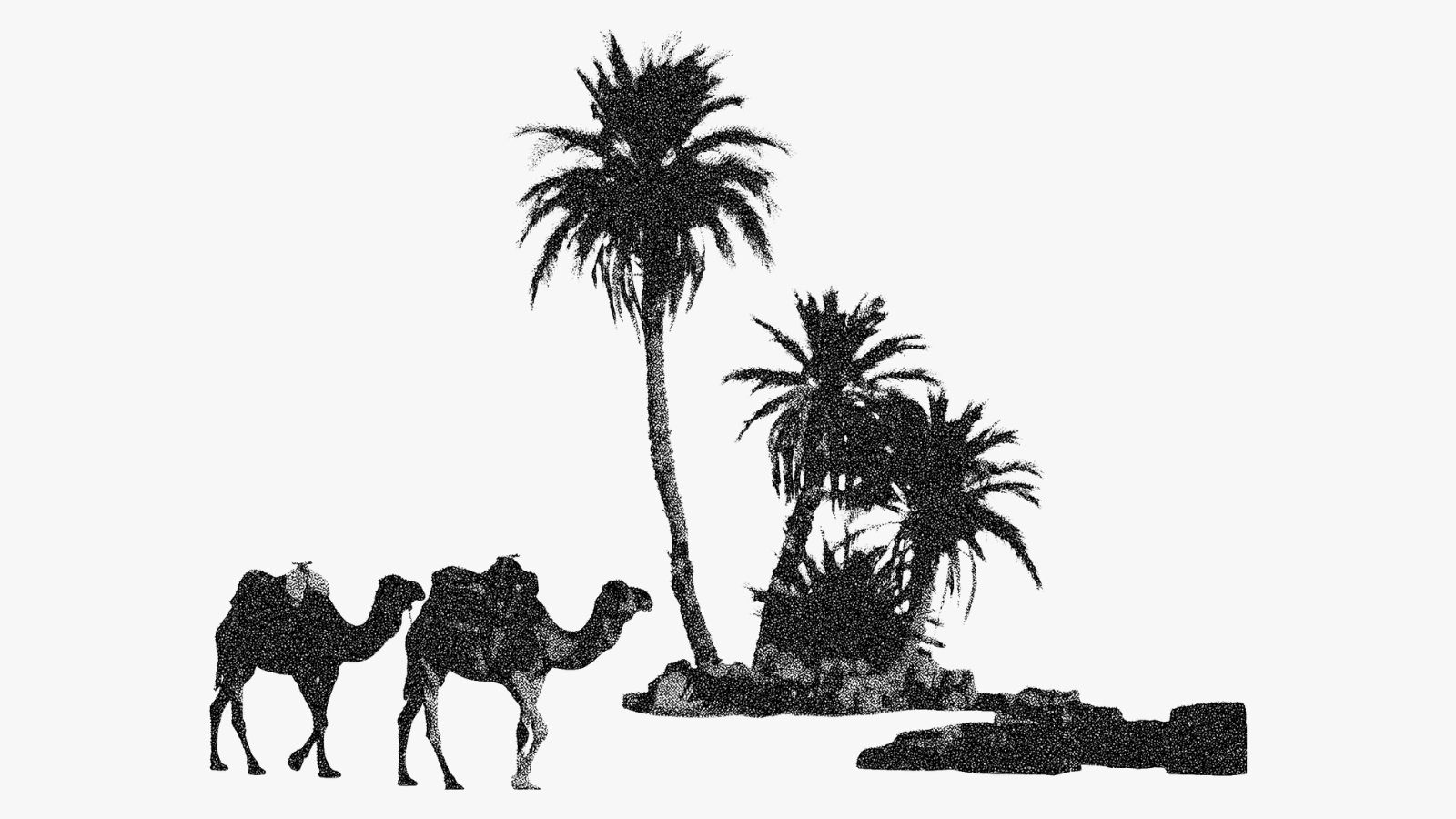
It wasn’t the desert I imagined. The desert is never the desert. To the side of the tent, Yussuf unfolded a rug, three chairs with adjustable backrests, and a golden teapot. He lit a fire on top of the ashes of a fairly recent bonfire and made tea. The dunes, the sand, the tent, the solitude, the silence. The scene was so perfect that even the sky was willing to give us a picture perfect sunset. Then came the words. A visit to the desert is also a conversation in which stories fill with substance the absence of place, or rather, the excess of place. On the outskirts of Bou Saada, the Algerian city known as The Gates of the Desert, our imagination explodes and we are a caravan of travelers amidst the wind, the sand, the thirst, the cold, the dark night—strangers who mingle in conversation where stories thicken the void. Yussuf speaks of the invasion, the Jews, the cheese, Queen Kahina, women and their place in Islam, but also about the World Cup and the remote possibility of Algeria beating Argentina. Something about the sudden intrusion of football along with the arrival of another 4×4 carrying three young people with small plastic bottles of mineral water threw my imagination off a bit. It seemed fabricated, inauthentic, as if it all were a desert-stage set on the desert itself. The experience of inauthenticity is not just about a superimposed backdrop, but about an inorganic distance from things: we were in the desert, but the desert was not the desert, it was what we imagined the desert to be. Through movies, books, advertisements. What is a desert? The photograph came to life so that we could all be content: us on our trip to the desert, them satisfying the customer, our social media followers with the images of the landscape. That’s what it was: we were inside a landscape. The 4×4 we had arrived in was still playing the music we were expecting—a mixture of ancient Algerian songs with some reggaeton, Maghrebi culture ready for consumption, like lunch with its typical dishes or the traditional hotel furniture. We couldn’t even confirm if Yussuf’s name was actually Yussuf. Or if his stories were true. The scene of the desert and the induced emotion. We were still tourists, even though our objective was different: to find in Algiers the house where Jacques Derrida was born. Inauthenticity at its worst: a desert designed for tourists is no longer a desert. Or it’s a desert in the same way a shopping mall is. In a shopping mall, nobody feels like a stranger, but in «the desert within the desert» we are all foreigners.
What is this scandalously disguised line that distinguishes tourists from foreigners? Who is the counterpart of a tourist? What is its opposite? The local? It depends on the nature of the opposition, as it can also be a traveler, or a migrant. Or an undocumented immigrant. Or a refugee. Or an exiled. I am in Algeria looking for Derrida’s house, perhaps to find myself: what category do I fall into? Inauthenticity is a prolific factory of authenticity: something like an inauthentic authenticity. What is this scandalously disguised line that distinguishes the authentic from the inauthentic, the spontaneous from the artificial, authenticity from marketing? Yussuf’s story and his family’s experiences during the Liberation War moved me deeply. The shock is always real, whether it happens in the street or in a theater. It reminded me of a trip I took quite a few years ago to the Majdanek extermination camp in Poland. While visiting the inside of a gas chamber, the tour guide turned on a speaker at full volume so we could listen to the heartbreaking music of Yerushalayim shel zaav. And it was indeed heartbreaking. And we continued on our journey ever so more determined and committed to our true selves. But the heartbreak implies a separation, something that no longer works. Perhaps it’s a matter of giving a little space to something that no longer fits—not so much understanding who I am, but rather what they have made of us. Always trying to delve into what came before, what Derrida calls «the desert within the desert». Or imagination within imagination. Or emotion within emotion. What will Yussuf be like at home drinking tea? Does he brew it just like this? Does he think of his family being tortured during colonial times? Does he drink this herbal blend or does he prefer a Twinings teabag? Is there a Yusuf, or is Yusuf himself this scandalously disguised line? Could it be that I am Yusuf?
***
I am in search of Derrida’s house, the house where he was born in Algiers, but for Derrida, the origin is the footprint. What is a house on a footprint? Why insist on the house? Why insist on the origin? Whose home is it behind the home behind the home, behind a bottomless past? Whose land is it? Whose land is it if each layer of land is built on top of other layers of land? Or worse, whose sand is it? Whose sand is it that is never the same and therefore never is? Are we actually dwelling on who owns the sand? That’s the paradox of the desert, there is no possible trace since footprints in the sand are always erased by the wind. Is the wind the one and only footprint? But isn’t the wind that which is always yet to come?
Will I find any evidence of deconstruction in Derrida’s house? Deconstruction, says Derrida, is an experience of the impossible. But how can one experience what cannot be experienced? Something about Yussuf doesn’t sit right with me, just as the music in Majdanek didn’t sit right with me, just as any forced return to a past of closed and definitive origin has always struck me as jarring. The longing for the Adamic past: everything tracing back to a single and absolute beginning. And yet I let myself be captivated, because spells stir emotions. Night falls in the desert as Yussuf tells us in excellent French about his uncle’s struggle against the French colony. Bou Saâda is not Algiers. It is more than four hours away from the Mediterranean metropolis and into the inland desert. And as we go deeper into the road, fewer and fewer traces remain of the dual language. In Algiers, almost everything has its French translation, but on the way to Bou Saâda, French gradually disappears. But we are tourists, and Yussuf is our guide. There is no greater experience of the impossible than a tourist exploring the territory. Yussuf tells us that he has family in France, like almost all Algerians, and that he really enjoys traveling around Europe. There is a space where we all converge and where the structure strives to be as little hybrid, confusing, and Babel-like as possible. Bou Saâda was a land of diverse cultures, including a large number of Sephardic Jews. But our times are times of purification and the narrative is surgically redefining its boundaries. All that remains is the idyllic memory of a diverse world that succumbed to the interests of the enemy. And it’s clear that the category of enemy is void of content. That is why Derrida says that everything can be deconstructed. But he also adds that the undeconstructible exists. All stories can be deconstructed. All this staging, all this order, all this emotion, all this show. And yet, unexpectedly, the sky unleashes a breathtaking mix of colors, and something doesn’t quite add up. A vermin climbs onto the carpet that’s just been vacuumed, and something doesn’t add up. We hear a distant scream, indistinct, that we can’t quite understand. We see a plastic candy wrapper drifting away across the sand and something becomes unhinged from time and space. The memory of a drawing of camels on a page from a children’s book I studied at a religious school—a book that told the story of three angels arriving at a tent—suddenly comes to mind. But there are no camels or angels here and, according to the tag, the tent was made in China. Everything that is revealed to us can be deconstructed, and everything we assume is underneath can also be deconstructed. And yet there is that which cannot be deconstructed, like an excess, here and there, throbbing…
Why did I go to Algeria? The deconstructible: to find the house where Derrida was born. The undeconstructible: will this journey transform me? The deconstructible: I’ve never been to an Arab country and I never thought I would visit one. The undeconstructible: will I be able to step outside of myself a little? The deconstructible: at some point in his work, Derrida begins to spread pieces of information about his childhood in Algeria with a clear impact on his ideas. The undeconstructible: how did I become who I am? The deconstructible: arriving at his house will allow me to see something beyond the cold description of his childhood. The undeconstructible: even the past is always yet to come. The deconstructible: experiencing the feeling of otherness. The undeconstructible: true hospitality, the impossible kind, is always for the hostile. The deconstructible: the desert. The undeconstructible: the desert within the desert.
***
Everyone was smiling from the moment I got to the airport. And everything revolved around football. The World Cup was just around the corner and Algeria and Argentina were going to be rivals. The immigration officer who greeted me very kindly and spoke basic French had mistreated the previous passenger, who was referred to another official. My first real fear was the airport. We had been awarded the visa without any issues, but for some reason I was suspicious. With Luciana Garbarino, editor from the Dipló who came with me on the trip, we had to leave our passports at the Algerian Embassy in Buenos Aires, but we weren’t given any evidence of its receipt. Later on I learned that many Europeans are denied an entry visa, especially journalists, and that Algeria is one of the strictest countries in granting visiting permission. My travel companion, who was going to act as translator, finally withdrew the passports where our status was stated clearly: tourists. The immigration officer asked me once again: «tourist?» Yes, tourist, I replied. The entire six-day trip consisted of a kind of Marranism that downplayed our purpose of going in search of Derrida’s childhood home under the guise of being ordinary tourists. Perhaps calling us Marranos is too strong, since it was not a matter of concealment but of displacement, another interest that formed part of our journey. We sensed that it was better not to present the trip as motivated solely by the “Derrida objective”, and the cost was a tourist visa which placed us within the framework of how Algeria treats tourists. I don’t even know if we would have encountered a different side of Algeria if we hadn’t stated we were tourists, especially since I don’t know under what category we would have been registered. There were no other options.
In any case, in Algeria it made more sense to be a tourist interested in Camus, or even more so in Saint Augustine. But how about a tourist interested in Derrida? Nobody, absolutely nobody on the street knew who Derrida was. Taxi drivers, hotel staff, people we passed somewhere. Not even in a couple of bookstores we asked around knew about him. And why should people in Algeria know who Derrida was? Why should they know he was born in El Biar, a Algerian neighborhood, in 1930? Derrida, the French Jew who left Algeria at the age of nineteen and who, according to certain testimonies we got during our stay, was not very supportive when the national revolution achieved Algeria’s independence. Could all this have something to do with the way Derrida spoke in his later years about an incipient nostalgérie?
How does a thinker’s work relate to their own biography? And how does a thinker’s work relate to his own biography when his childhood was decidedly problematic? And what does it mean that it was problematic? Or the other way around; why not consider that a philosophy–that exegesis of the body, as Nietzsche would say–is nothing more than an escape, at most an attempt at salvation, or rather, redemption. Could it be that when Derrida speaks to us about hospitality, he is at the same time speaking to us about those marks that come from a youth in war-torn Algeria that expelled him from school? Could it be that when Derrida speaks to us of différance he is also speaking of having lived in Algeria, where he never learned to speak the Arabic language or the history of the place where he was born? Could it be that his unique way of writing, thinking, and inventing has something to do with the impropriety of having always been a French Jew born in Algeria? Or a Jewish French born in Algeria. Or a French Algerian of Jewish origin. Or an Algerian Jew who became a French citizen, like all Algerian Jews who were incorporated into French citizenship after the Crémieux decree of 1870, creating a fundamental secession from the Maghreb world.
***
Having settled in Algiers, we headed to the first address we thought could be Derrida’s house. In some of his books he mentions his love for a house with a garden, in the neighborhood of El Biar, number 13, D’Aurelle des Paladines street. There is a biographical vagueness that we decided not to delve into. It seems that little Jackie was born in a house in the neighborhood of El Biar, rented for a few seasons, then moved to another house on Saint Augustin street, closer to the center, and finally settled with his family in a different house in El Biar, on D’Aurelle des Paladines street, where he grew up. El Biar is a neighborhood of a certain prestige. It remains so to this day. We took a taxi to the first address that the Gemini chat app had translated for us: number 13, Koudi Mohamed street. After 1962, with the independence, the old streets named after French heroes, leaders, and generals were replaced by the names of fighters at the different stages of resistance of the Algerian people throughout the one hundred and thirty-two years of occupation. We trusted the chat app because its answer was categorical: the old Rue D’Aurelle des Paladines is now called Rue Koudi Mohamed. And there was also a place with the number 13: it was a mini market. A quick market. While my colleague asked some questions to two young men in charge of the cash register, I walked through the store’s aisles: they were an exact copy of the Chinese supermarket around the corner from my house in Florida, a neighborhood in Vicente López. It wasn’t a resemblance but a carbon copy: cleaning products, dairy products, cookies, drinks, even some brands of pasta were the same. I felt at home. Or at most right around the corner, on an errand to buy a snack for my son in the afternoon. The boys at the checkout, who were no more than twenty years old, began looking at their cell phones for more information about our search. Nobody knew anything about Derrida, or the old name of the street, or anything. But the chat app used by one of the boys, under a similar interrogation to ours, yielded a different result. Even today I’m ashamed of having thought, «How come the chat suggests a different address if the question is exactly the same?» Throughout the rest of our trip through Algiers, the chat never repeated the same address again. There is the undeconstructible, its name is Babel.
One of the young men invited us into the back room so we could talk to an older gentleman who we couldn’t quite tell whether he was the owner or a manager. He greeted us far too politely from behind a wooden desk that looked from the 1950s. Everything was very disorganized, surrounded by boxes everywhere. A cat was dozing among the boxes. The contrast was striking: the young people spoke French, used the same brands of cell phones as we did, and dressed like any teenager from anywhere in the world. The older gentleman, however, seemed to come from another world: he was dressed in an elegant old suit and, with a movie-star smile, he spoke to us in Arabic. He didn’t speak French. We understood each other using signs, gestures, words written on paper. His willingness to give us an answer clashed with the very impossibility of communication. Something about hospitality always hinges on an impossibility. Derrida also mentions this in his texts: the root of hospitality is associated with that of hostility, since true hospitality is always directed toward the hostile, toward that which is hostile. We could understand his apology in his words: I am not Algerian, but Palestinian. Only the man with no home seems to double his effort to make us feel comforted. His selfless generosity surprised us, even made us suspicious. He asked us to go with him, and we walked towards a house located around the corner. He clapped his hands together, but nobody answered. One of the young men who didn’t give up the research in his cell phone told us that the street wasn’t formerly known as D’Aurelle des Paladines, but Saint George. The source: the same chat. As in Borges’s story, Pierre Menard, Author of Don Quixote, the technology is always the same, but the contexts are always unique. In the biblical story of Babel, human beings try to build a tower to reach heaven and emulate God, but such pedantry receives a punishment: the unintelligibility of languages. The species splits and there is no longer a common language. Or was there ever one? Derrida begins his book Monolingualism of the Other with this sentence: “I have only one language, and it is not my own.” Almost as if that supermarket had to be what became of Derrida’s house. And why not? Why did we trust, believe in, and have faith in the answers we were receiving? «Go to the Mayor’s office, they must keep a record of the street names» was the common response we would get every time we came across the impossible. And why trust the Mayor’s office? Nobody remembered anything about Algiers before the revolution. What became of Babel? What if the tower was finally built? I couldn’t tell if I was in Algiers or Buenos Aires, as I wandered among Nesquik, Nestlé, Coca Cola, Nivea and other names. Outside there’s the desert, but isn’t there more desert between these aisles?
***
I keep searching for the desert in the desert, the house in the house, Babel in Babel, hospitality in hospitality. Our trip to Bou Saâda lasted two days. The next day Yussuf referred us to Mohamed, another local guide with whom we visited a small waterfall teeming with children swimming and playing. Mohamed hands out some coins to one of them for him to pick up trash, papers, and wrappers from the floor. The boy’s name is Issam, which means something like «to tie a rope to God,» «to cling to God.» He must be eleven or twelve years old and is wearing a Barcelona shirt with Messi’s name on the back. The news that we are Argentinian doesn’t affect him at all. We don’t speak the same language and everything becomes an exchange of friendly gestures. It wasn’t the desert I imagined. Yussuf’s and now Mohamed’s stories present us with a harmony that is too perfect to be real. It’s not even a marketing strategy, but a revisited traditional condition: being open to foreigners. But the question remains: is a tourist a foreigner? Yussuf places greater emphasis on Islam while Mohamed focuses on Berber roots, but both speak of the pacifist vocation of the Muslim world and its rejection of fundamentalism. The photograph tries to capture this new sign of the times through an axiology of encounter: the world is divided between those who seek dialogue between peoples and those who build violent walls aimed at the annihilation of the other. Here in Bou Saâda there was a significant Sephardic Jewish community, but with the Crémieux Decree of 1870, which granted French citizenship to Jews living in Algeria and not to Muslim Arabs and Berbers, the Jews chose to be French, Yussuf tells us, trying to categorically differentiate Zionism from Judaism in a web that included the historical controversy between Algeria and Morocco and the neighboring country’s current support for Israel. Was Derrida Jewish? «There were no Jews left here after 1962,» he confirms. We asked him about Islam, about family, about women, about clothing. The more my travel companion and I push the boundaries of the narrative, the more the contradictions between universalist yearning and the exclusion of others come to the surface. Perhaps this is the only major tension in any culture: how can one uphold universalism from a position of particularism? The condition of the tourist springs from the same matrix as the arrangement of food in the supermarket, and in the world of photographs it is no coincidence that we spend all our time posing. Still, a pose is not necessarily something false. Sometimes it is a way of pursuing a desire or recovering a vocation, or of opening the door to ghosts. Every element of the photograph is real. It’s only a matter of looking at what swarms out of the pose. Historically, the desert has welcomed foreigners. But who are the foreigners today? Where should we draw the borders?
We left the supermarket for yet another address that the chat pointed out for us. The number was always 13, but this time the technology sent us to Rue Ahmed et Boualem Khalfi. We walked for a few hours heading down, toward the most central part of Algiers the White. The hills and the sea make Algiers a city of contrasts, striking. As we descend the winding slopes, the sea becomes, in the distance, a horizon of imposing beauty. The neighborhoods of El Biar and Hydra have architecture similar to that of elegant neighborhoods anywhere in the world, but in the center of the city the French atmosphere from before independence endures. We could easily be walking through some Parisian neighborhood of the last century. There are cafés, there are pastry shops, and there are cats. The whole city is full of cats. And I mean everywhere. There is no spot without a cat lying in some corner. The book with which Derrida steers into the animal turn of his work—The Animal That Therefore I Am—begins with a scene in which a cat watches him as he steps out of the shower naked. That gaze of the cat sets off a whole series of reflections on difference. The otherness of the animal. And the otherness of the otherness of the animal. The animal we construct for ourselves and the animal we leave outside. We don’t feel the cats’ gaze quite so specifically, but they are there, always, at that crossing between the divine and the scenery. The feline presence is almost omnipresence, and for that very reason what we slowly begin to notice is the absolute absence of dogs. In our six-day trip through Algeria, we came across three dogs at the most, each one firmly leashed. Never a dog on the loose. And in another version of Babel, we couldn’t find a consensus in the answers we gathered about the absence of dogs. Why are there so few in Algeria? Our suspicion of a religious motivation was constantly dismissed with arguments such as the notion that dogs live in houses in the more rural areas, or that there is a tradition that makes dogs more domestic animals that rarely go out on the street. There’s even the idea that they require superlative supervision because of the aggressiveness of the species. In fact, we witnessed a scene in which two women demanded that a man hold tightly onto the leash of a dog fitted with a snug muzzle. In the desert, Yussuf told us about a certain religious imprint that seems to regard dogs’ saliva as impure. Why was there no agreement? There appeared to be a determination not to give us a ritual explanation for the absence of dogs. It seemed as if even stating it would be sacrilegious. Or as if it were better not to go into it, better not to talk about it. We could feel discomfort when faced with our question. And besides, nobody regarded the absence of dogs as an absence. That was what surprised me most about the people we spoke with: their conviction that there was no dog issue and that their scarcity wasn’t so.
Derrida speaks of democracy as a democracy yet to come. Democracy can never be understood as an accomplished state, because there is always an other, someone is always left out. The problem with otherness is that at every present moment the exclusion is denied or, at most, justified as a legitimate exclusion, whether it concerns an animal, a people, a person, a trade. That is why democracy can never be satisfied or be considered as consummated, even if the expansion of rights seems to have reached its end. Democracy is never finished because there is always an other. And there is always an other because of the paradox of otherness: the other in its most radical manifestation always eludes us, and yet it is democracy’s only calling. Democracy is always yet to come because its purpose lies in keeping a watchful eye on those who in each new present are excluded from history and try to make themselves heard. It takes active listening. These voices are not out there, beyond, but very close by. They live alongside us in everyday life. And we need to listen to them in all their difference. It’s a shout, an outcry, a lament, a whimper. The radical other is not recognized as an other: therein lies its otherness. Foreignness is not a matter of nation-states but of how we interact with otherness. For all these reasons, not even the radical other is a victim. It cannot be recognized as one. Its exclusion, its stripping of rights, its extermination are necessary to uphold the system. It cannot be a victim because its oppression, its exclusion, its disappearance, its annihilation are functional to its inner workings. The scapegoat is never recognized as a scapegoat, because otherwise the whole apparatus by which someone always has to remain outside so that the inside grows stronger would be revealed. Even, paradoxically, the inside tends to describe itself as a victim, as a way of over-justifying the need to annul the other. Who is the victim? Who is the inside and who is the outside? Isn’t there more outside within the inside? The undeconstructible: the outside of the outside, the victim within the victim, once again and always the desert within the desert.
***
And so we arrived at the second address of the alleged house where Derrida spent his childhood days and, much more clearly than at the quick market, we realized that this low-rise building wasn’t the place. We were also far from El Biar by then. On the facade, a plaque stood out with a name and a profession: a doctor specializing in the lungs. A pulmonologist, like Maimonides. The need to find a connection between signifiers had by now reached the point of desperate impulses, frantic signals, forced signifiers. Even so, the long walk between the two non-houses showed us different features of contemporary Algiers. We were looking for a kind of metaphysical impregnation to understand the context in which Derrida’s philosophy was created, but this Algiers barely resembled the former Algiers at all. For one thing, that one was a colony of France and this one is an independent nation. Identification with the independence struggle was very close to the surface, more among older people than among the young, but we had a hard time hearing any bitter testimony about the French. The defense of autonomy came across to us as an unquestionable fact, but a certain something of the French still spreads through the city: from the language, through the architecture, to a certain friendly sense of closeness. The Algerian diaspora in France is staggering and, somehow, perhaps for that very reason, no hatred is perceived. Nobody forgets the dead, but it’s as if anger at the colonizer were confined to the historical account and didn’t reach the same intensity in the present. Or perhaps only to some more ambiguously explosive state, like one that gets a flash of pain from the past and gets angry. Or perhaps they talk to us this way because we are tourists. They speak to us in French about their bond with France, which is also the West. On the way down toward the center we came across many gigantic murals filled with hand-painted heroes. The faces, the bodies, the embraces, the struggles. But most of them belonged to one of the two big football clubs that, just in those days, were facing each other in the final of the Algerian Cup: USMA and MCA. Algiers is full of murals and banners on every wall of the city. What at first glance look like historical evocations turn out to be expressions of football fanaticism. Us being Argentinian invited every Algerian to talk about football with us. Not only about the upcoming World Cup, but about the Messi-versus-Maradona debate. And the answer was all too obvious: young people chose Messi, everyone else, Maradona. Over those six days we must have come across at least ten children wearing Messi jerseys, but all of them old, from when he played in Barcelona. At the crossroads of modernity and tradition, something about the experience of time became challenging for us. Derrida’s nostalgérie is perhaps less about a state of mind than about an anchoring in time. As if his nostalgia for Algeria allowed us to encounter a nostalgic Algeria, but not one nostalgic for any particular historical moment. There is a temporal lag that proves hospitable, since it invites us to move forward from a certain pause. Perhaps the desert within the desert is that drive that fuels the search for the origins. The search for the impossible house in the desert.
From the waterfall at Bou Saâda we went deeper into the desert, to a smaller village a few kilometers away. Its name: El Allig. It was there that Mohamed invited us into a mosque. A very humble building with bare walls, where ritual elements coexisted with a microphone, some old speakers, a cell phone charger. The emptier the house within the house, the closer we feel to that certain something that throbs there among the bricks. There is too much silence in El Allig for us not to hear a little beyond. Or a little of a certain beyond. The rites, the repetitions, the religious institution come later; but just as every prayer halts something of time’s frenzy, every house of God dislocates space. We are inside, but we feel outside the inside. As if we were inoculating the outside into our interiority. Mohamed explains things to us and right there the whole epiphany dissolves. Words lose their pulse in their rhetorical eagerness to explain, to convince, to justify, when everything has already been made more than explicit by those humble walls that could be the walls of any synagogue, any church, any desire to understand our nomadism before the house within the house.
After the two failed attempts, we decided to do without the technological crutch for a while. We went to see the Casbah, the historic quarter of Algiers, with its cobblestone streets that get lost among curves and corners. The Casbah sits on a hillside, so we kept going down toward the sea. Giving up the search for a few hours was the key—almost in a deconstructive register—for something different to happen: a group of women wearing no veil or any kind of traditional clothing approached us to ask if we needed anything. Throughout our trip in Algeria we came across many different styles of clothes among women, including a small percentage who wore no particular garment. In a highly enunciated French, they expressed their surprise at our nationality, and when my travel companion told them about D’Aurelle des Paladines street, they began an inquiry that culminated in a voice message from someone convinced that the street in question was located behind the market at Kennedy Plaza, which is named that because apparently Kennedy was one of the first to recognize Algeria’s independence. And so, amid bluefin tuna, fruits of every kind, electrical appliances, and football jerseys, we found a street just a few meters from the market with a door that displayed the number 13 and, behind it, a garden and a small, elegant house. «This is it,» I told my travel companion. Not only did everything match the few biographical records we had on Derrida, but through a mixture of intuition and certain facts that began to flow in, everything kept pointing to the fact that we had finally arrived at the house. We knocked on the door, but nobody answered. We crossed to a butcher shop across the street, where they didn’t recognize the name D’Aurelle des Paladines, but when they heard the word “Derrida”, they told us it was the right house. The butcher crossed with us and knocked a little harder. We heard voices until a woman opened the door and, very kindly but at the same time somewhat hurriedly, told us they had been living there since 1964 and that she had never heard the name Derrida. She spoke French and a little Spanish. Something in the way she spoke to us confirmed my suspicion that we had found the place. It wasn’t a tension between kindness and haste, but between kindness and reticence: she wasn’t trying to help us because something didn’t sit right with her. We stood next to the house as people began to gather and ask what we were looking for. It was very common for people to approach us all the time to start a conversation and introduce themselves in order to help with whatever we needed. We were never able to fully give ourselves over to such a gesture, because a kind of structural distrust always held us back: we didn’t understand what the interest was when it might have been a disinterested gesture. A woman told us that the owner of the house was named Frédéric and that he worked at the French consulate. Another woman whispered in my ear: they’re Jewish. At that point I had no more doubts. They say that only between 500 and 2,000 Jews live in Algeria. It was too much of a coincidence. Jewishness was too strong a link to Derrida. My subjective certainty was so overwhelming that there was no way to convince me that this house wasn’t Derrida’s house. It even looked very much like some photos published alongside the book Circumfession. Everything fit, except the woman’s testimony. Had she withheld the information out of some kind of fear, caution, prudence? Someone knocks on the door and asks questions.
All my life, I realize, I have declared my own Judaism with a certain restraint. With the Crémieux Decree, the French found in Algerian Jews allies they needed for their presence in Algeria. French citizenship brought them closer to France, but distanced them from Maghrebi Algeria. Colonial Algiers presented itself as a European city that occluded every native trace. For the Maghrebi Algerian community, the Jews had chosen to be French, occupiers that is. Jews who, like Derrida’s ancestors, had lived in harmony with the Islamic world in the period before the colony. At the same time, many Algerian Jews, including the Derridas, also became Frenchified in terms of a certain secular assimilationism, very typical of European Jewish modernity, which gradually diluted the traces of belonging. Derrida recounts that circumcision was called «baptism» and the bar mitzvah «communion,» and that Jewishness had become something rather symbolic. For this reason, the outbreak of the war had an unexpected and devastating impact: under the Nazi occupation, the new France revokes the Decree, enacting the most violent anti-Jewish laws. The French allies turn their back, and the Jews end up in a confrontation on two fronts: with the French and with the Algerians. Little Jacques is expelled from school and receives his first insults in the street for being Jewish. With the end of the war, the Crémieux Decree goes back into effect, but for Algerian Jews there is now a rupture that cannot be overcome. Derrida lives the experience of not feeling at home anywhere. His testimony, cited by Benoît Peeters in his biography, begins in the midst of the war, when, faced with the ban on Jews attending school, the community organizes schooling away from the official system. Jacques, however, doesn’t feel comfortable anywhere. At the same time that he was angry about the discrimination of French Algerians, he didn’t feel at all at ease with the endogamous ways of the Jewish community. But what he clearly did not experience in those days was any attachment to Maghrebi tradition. His course was set for France, aporias included. And the main aporia was his paradoxical condition of neither/nor: neither absolutely Jewish, nor absolutely Algerian, nor absolutely French. Nothing at all. The Jews of Algeria left the country en masse after 1962, the year of independence. We had come upon the house of one of the few Jews who still lived in Algeria and who for some reason hadn’t left. The woman’s reticence at our arrival was hardly surprising. The undeconstructible: isn’t that «neither/nor» a condition that, outside of all universalism and particularism, finds us sharing, as Roberto Esposito would say, a nothingness, a lack, a desert within the desert?
***
On our return from Bou Saâda we received an email with a reply from Sofiane Hadjadj, an editor who had published a book on Derrida in Algiers more than twenty years earlier. Sofiane had become our last hope, especially because he had told us that, at the time, as part of a colloquium on Derrida, all the participants had gone to visit the house where Derrida used to live as a child. Sofiane didn’t remember the place, but we arranged a lunch at the home of an acquaintance of his, where he hoped to track down this information. His account of why Derrida is so little known in contemporary Algeria centered above all on the ambiguous position Derrida took regarding the revolution: there was no eloquent support on his part. The undeconstructible: identity, too, is always yet to come.
Unexpectedly, Sofiane’s acquaintance was named Frédéric, and so, incredibly, we went back to number 13 on the market street to once again meet the woman who, it turned out, was Frédéric’s wife, one of the few Jews who still live in Algeria. «Jacques Derrida lived here, didn’t he?» I asked her. And she pointed to an adjoining structure that was part of the property: «No, he lived there, right where there’s a building under construction. The Derridas lived there until 1962. My grandfather rented them the place.» It wasn’t the house I imagined. The problem wasn’t so much the number 13 and its possible shift, or the initial silence of Frédéric’s wife, or even some testimony I had read in Peeters’s biography, in which Derrida says his parents had bought the property. All of these discrepancies seemed to me easy enough to resolve. The problem, or perhaps what was problematic about what Frédéric pointed out, was that it was a house under construction. And half-built. In that intermediate, processual state, where the end is still hard to make out and everything seems too unfinished, with pipes scattered across the sidewalk, bags of sand enduring the intermittent rain, rooms still missing a wall. The real estate project was enormously far from what that house had been, which according to Frédéric was similar to his own. We toured Frédéric’s house and in some way had the impression of having toured the Derridas’. But it was all part of the facsimile. Of the facsimile and of the footprint. Or is the copy the footprint? What did I ultimately come to Algiers to find? What connects us with the figures we look up to? Why did I go in search of Derrida’s childhood? Why did I want to visit an Arab country? What does this journey say about my own wandering? Why does the desert call to me so much?
After six days I began to feel less like a stranger in Algiers. All those small details that make up an identity were becoming part of our daily routine. Turns of phrase, names of typical things, ways of driving, the layout of the neighborhoods, that hospitable manner that at first sparks rejection and that we slowly assimilate as ways of relating to the foreigner. Foreigner or tourist? The facsimile and the remainder. One can be a foreigner in one’s own land, while the tourist feels at home everywhere. Sofiane saw certain parallels between the idea of a cultural Judaism and that of a cultural Islam. Here in Algeria very diverse forms of Islam coexist, secular ones too, he told us. Every secularization is a covert form of continuity of that from which it supposedly breaks away. Perhaps hypersecularization is leading the world toward an inverted Babel, where we will all go back to speaking a single language. The question, obviously, is which language that would be. Or which one it already is. Especially because hospitality is always towards those who are hostile. Therein lies its difference. Foreignness is welcomed not only because of its weakness, but as a way of transforming those who inhabit their home. And in the desert there are no houses, only tents. And tents have no doors: whoever arrives enters and eats. Perhaps the desert within the desert is that originary void where we are all, in some way, others, foreigners.
* Filósofo.
© Le Monde diplomatique, edición Cono Sur